Trauma-Informed Forgiveness: Liberating the Oppressed, Reclaiming Agency, & Breaking the Cycle of Harm
Introduction – Why Forgiveness Needs a Rethink
Few words in the Christian vocabulary have been more distorted, weaponized, or misunderstood than “forgiveness.” In many church and societal contexts, forgiveness is asked from those who have been harmed—often quickly, publicly, and in ways that protect the comfort of the powerful and keep the oppressed in place. “Forgive and forget” becomes a silencing tool to maintain the status quo. Calls to “move on” bypass truth, justice, and repair. Perhaps even worse, performative acts of forgiveness are paraded as moral triumphs while deeper wounds remain unaddressed.
We need a liberative, trauma-informed, and biblical reimagining of forgiveness—one that centers survivors, breaks cycles of harm, and refuses to be co-opted by oppressive systems. This is not a rejection of forgiveness, but a reclaiming of its deepest purpose: healing and liberation for the sake of God’s holistic and just peace.
Unlearning Forgiveness Myths
Some wounds change the way you breathe. They change the way you trust. They mark you so deeply that the thought of forgiving feels like a betrayal of the truth. And you are right: what happened was wrong. Nothing about forgiveness erases that fact. But there is another truth: you do not have to carry the weight of that harm forever.
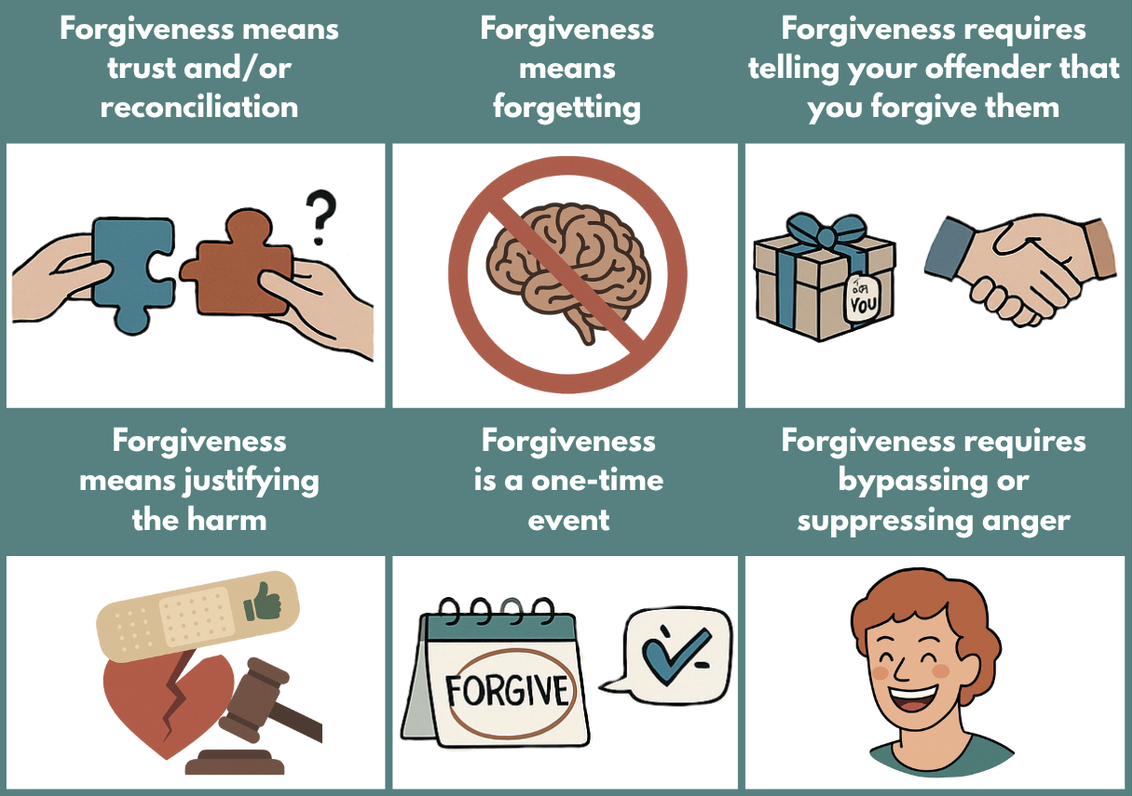
Forgiveness is so often misunderstood because it is wrapped in emotional, theological, and cultural baggage. Over the years, myths about forgiveness have taken root—myths that sound holy but distort its meaning, and in doing so, wound survivors further. The following figure names some of the most common myths that disguise themselves as truth.
These myths persist because they contain half-truths. For example:
Forgiveness may lead to reconciliation, but only when there is safety, honesty, and repair. Forgiveness and reconciliation are not the same thing.
Forgiveness often softens painful memories, but it does not require forgetting. Remembering is often essential for healing and justice.
Survivors can choose to discuss wrongs with the person who harmed them, but forgiveness is a personal, internal process—not something that must be shared or performed.
Understanding a perpetrator’s story helps cultivate empathy, but forgiveness does not excuse or justify harm, nor does it mean that justice will not be pursued.
Forgiveness usually begins with a decision, but it is rarely one-and-done. It’s often a long, unfolding process.
Forgiveness involves letting go of revenge, but it does not require suppressing anger. Anger is a valid human emotion and is often a vital part of healing.
Recognizing and refuting these myths helps communities recover a forgiveness that protects the oppressed and refuses to enable further harm.
The Primary Work of Forgiveness: Internal Healing & Liberation
Having cleared away the half-truths, we can now turn to the deeper reality of forgiveness. At its core, forgiveness is not about the perpetrator but about the survivor’s courageous reclaiming of emotional and moral agency—the refusal to let harm define the rest of one’s story. The cycle of bitterness and revenge is not only external; it lives within us as the urge to relive injury, to replay what was done, and to strike back in imagination or despair. Forgiveness is the inner decision to step out of that world—to say, “I will not be ruled by what was done to me.” It loosens harm’s grip and opens space for healing to begin.
Crucially, this inner work does not require contact with the person who caused the harm. Too often, survivors are told they must interact with their offender and verbally offer pardon. But such demands can re-traumatize, reinforce unsafe dynamics, and prioritize the offender’s comfort over the survivor’s well-being. True forgiveness can be entirely internal, because it is first and foremost about healing and reclaiming agency.
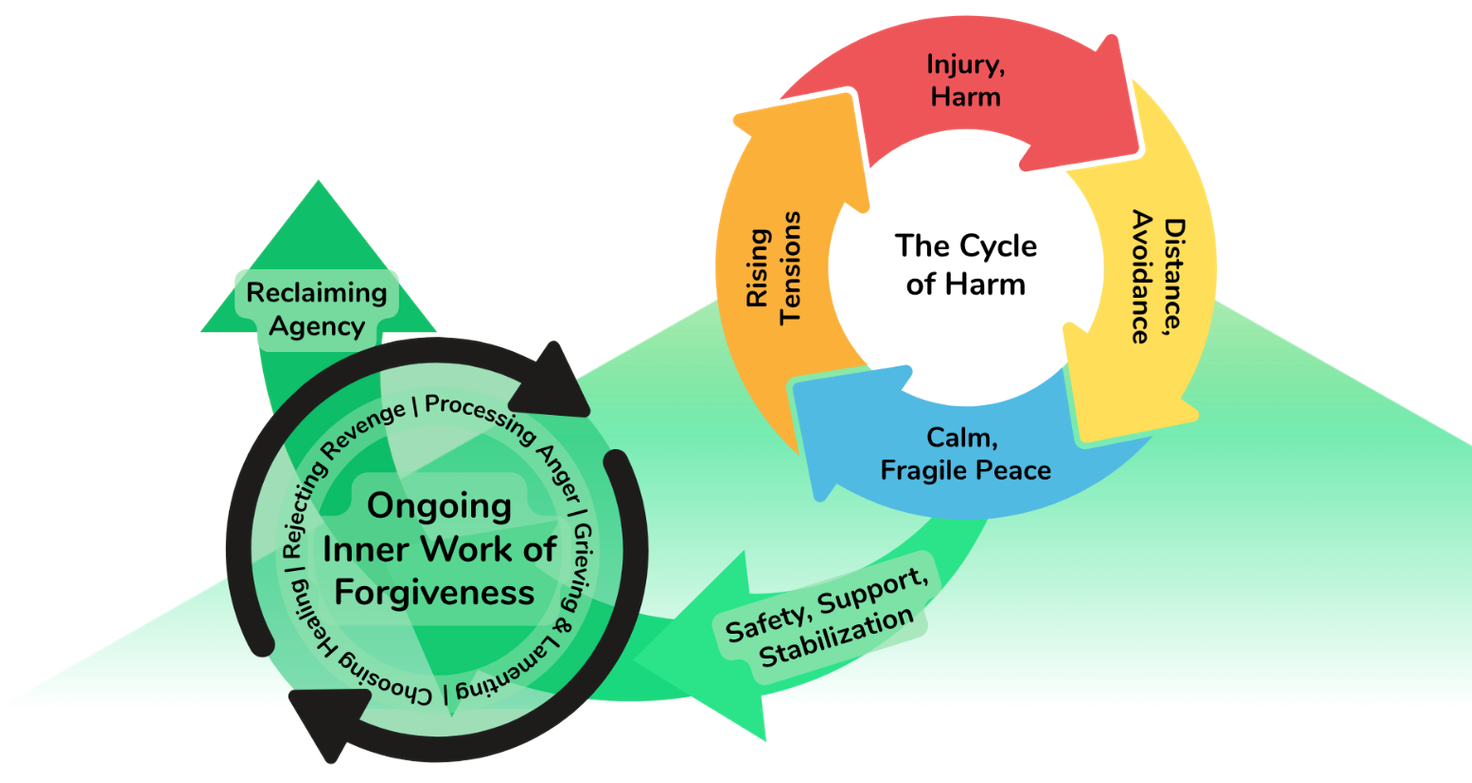
Forgiveness is not a single moment but an unfolding practice that moves through grief and anger, not around them. It requires safety, truth, and the presence of people who can hold space without rushing the survivor toward closure. In this way, forgiveness is deeply human and deeply resistant: it asserts that the one who was harmed gets to author their own story, without needing the offender’s permission or participation.
The Scriptures bear witness to how forgiveness begins as inner liberation. After years of betrayal, Jacob’s fear of Esau is met with embrace and tears (Genesis 33)—an outward sign that cycles of enmity had already begun to loosen internally. In the bitterness of barrenness and mockery, Hannah pours out her soul before God, reclaiming her voice and dignity (1 Samuel 1–2). And in the face of violence, Jesus refuses to return evil for evil, praying, “Father, forgive them” (Luke 23:34). In each case, forgiveness springs first from the heart, as an act of trust in God.
Forgiveness “from the heart” (Matthew 18:35) is not a demand for outward performance but a call to inner transformation. In Jesus’ parable, the servant who is forgiven a vast debt refuses to extend the same mercy to another. The king’s judgment comes not because the servant failed to make a public statement, but because his heart remained unchanged. True forgiveness aligns our inner life with God’s liberating mercy. It is the deep work of unhooking our lives from the corrosive power of retaliation and reclaiming the dignity God has given us.
This is why the primary work of forgiveness is always internal. Outward gestures—words to the perpetrator or public acts of reconciliation—can only be genuine when they grow out of this hidden transformation. Forgiveness begins where the will to retaliate and the reflex to relive pain both lose their claim on us.
The Public Gift of Forgiveness – A Discerned and Free Choice
Forgiveness begins as a deeply personal journey—an ongoing, unrushed process of healing, reclaiming agency, and choosing not to be bound by harm. For some, though not for all, this inner work may eventually give rise to an outward expression: the gift of forgiveness offered to the individual or group who did the harm. Yet this is always a matter of discernment shaped by safety, power dynamics, and repentance, and many survivors live free and fully practice forgiveness without ever re-entering unsafe or untrustworthy relationships.
When imposed or expected, offering the gift of forgiveness to a perpetrator can re-traumatize and silence victims. But when this act emerges from a place of inner freedom, it can become a profound act of strength. Survivors rooted in their agency may choose to express forgiveness to the perpetrator—not out of guilt or obligation, but as a deliberate expression of their moral power. In doing so, they affirm their own liberation and can open new possibilities for healing and new beginnings within their communities.
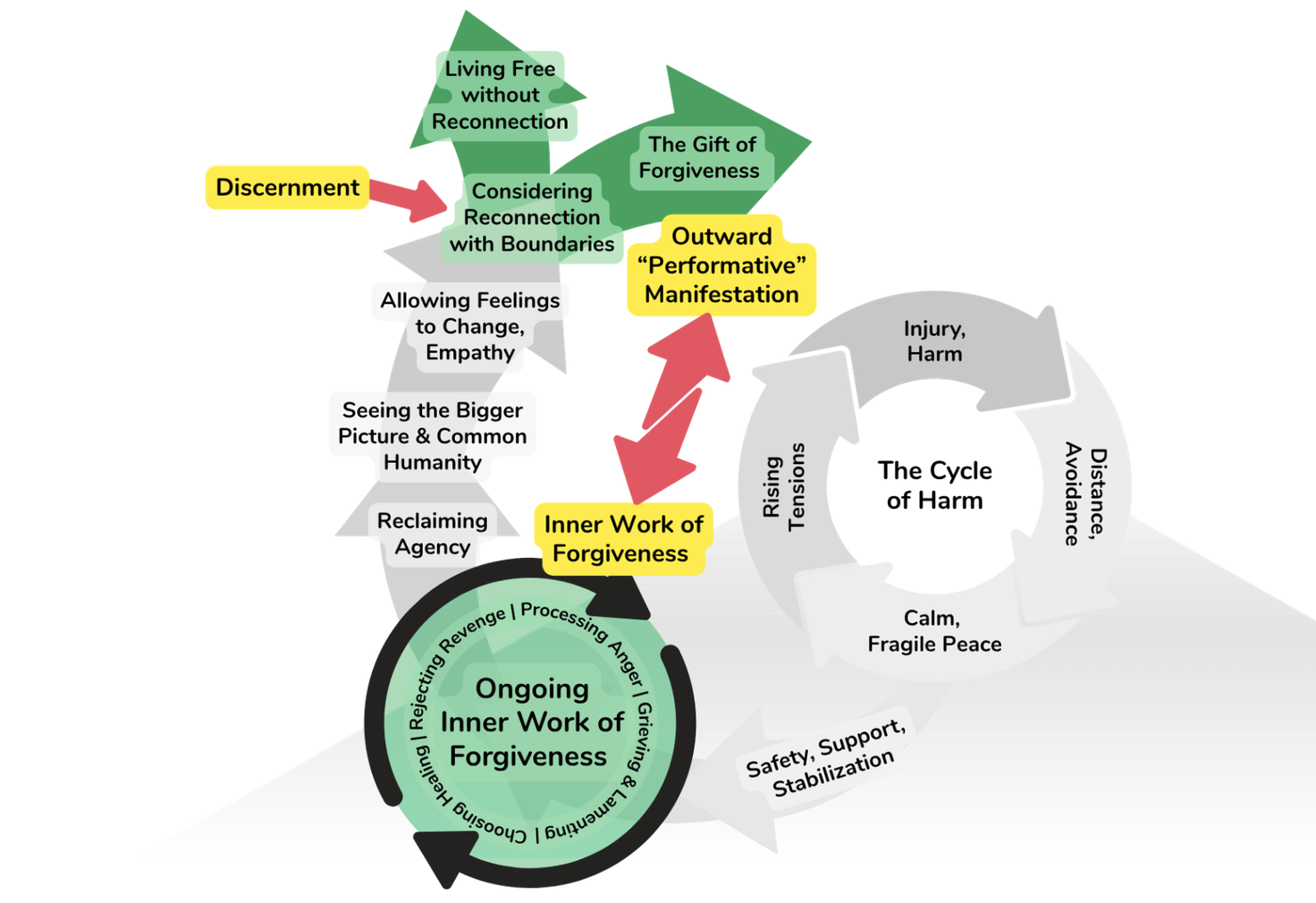
Importantly, outward forgiveness is not limited to situations where the perpetrator has repented. In Scripture, we see moments where expressions of forgiveness precede repentance: Jesus’ prayer from the cross (Luke 23:34) and Stephen’s final words to his executioners (Acts 7:59–60) reveal forgiveness as a radical act of inner freedom, not a negotiation. In recent history, survivors of violence—from post-genocide Rwanda to apartheid South Africa—have likewise offered forgiveness that disrupted hatred’s grip and sometimes awakened repentance in unexpected ways. This is perhaps the hardest form of forgiveness because releasing anger feels profoundly vulnerable—like opening oneself again to injustice, even if only in memory.
Such outward forgiveness must never be a strategy or an attempt to restore what cannot safely be restored; it is an act of moral courage and spiritual power. It frees survivors from the corrosive weight of bitterness and reclaims their agency even when reconciliation may remain impossible. Those who consider offering forgiveness outwardly must do so with care—discerning whether such an act supports their healing or risks being co-opted by religious expectations or oppressive narratives. Repentance and repair from the perpetrator remain vital for any genuine reconciliation, but they are not prerequisites for the act of forgiveness itself.
Case Study from South Africa: Justice, Forgiveness, and the TRC
South Africa’s Truth and Reconciliation Commission (TRC) remains one of the most globally recognized experiments in public forgiveness. Led by Archbishop Desmond Tutu, the TRC sought to heal the wounds of apartheid through truth-telling, forgiveness, and reconciliation.
The research of Dr. Lerato Kobe, a South African theologian whose work examines forgiveness and ubuntu, offers crucial insights into some of the shortcomings of the TRC. In Tutu’s earlier activism, justice was sought in the present. However, around the time of the TRC’s founding, his emphasis shifted—justice was increasingly deferred to God or intangibly hoped for in the future, while acts of public forgiveness became top priority.
This shift created deep tensions among survivors and among younger South Africans today. Many argue that the TRC placed a heavy burden on victims to forgive publicly, while the perpetrators’ work of restitution and systemic justice was underemphasized. Forgiveness, in this telling, became a political tool, soothing the conscience of the nation while leaving structural inequalities largely intact.
For those of us engaged in work for a holistic and just peace, this case offers a sober warning: when outward forgiveness is elevated without justice, it risks becoming a cover for the maintenance of power.
Forgiveness Breaks Cycles
At its heart, trauma-informed forgiveness is a refusal to remain trapped in the cycles that harm has set in motion. These cycles operate both internally—through bitterness, hatred, and the corrosive narratives of vengeance—and externally—through patterns of retaliation, enemy-making, and generational harm.
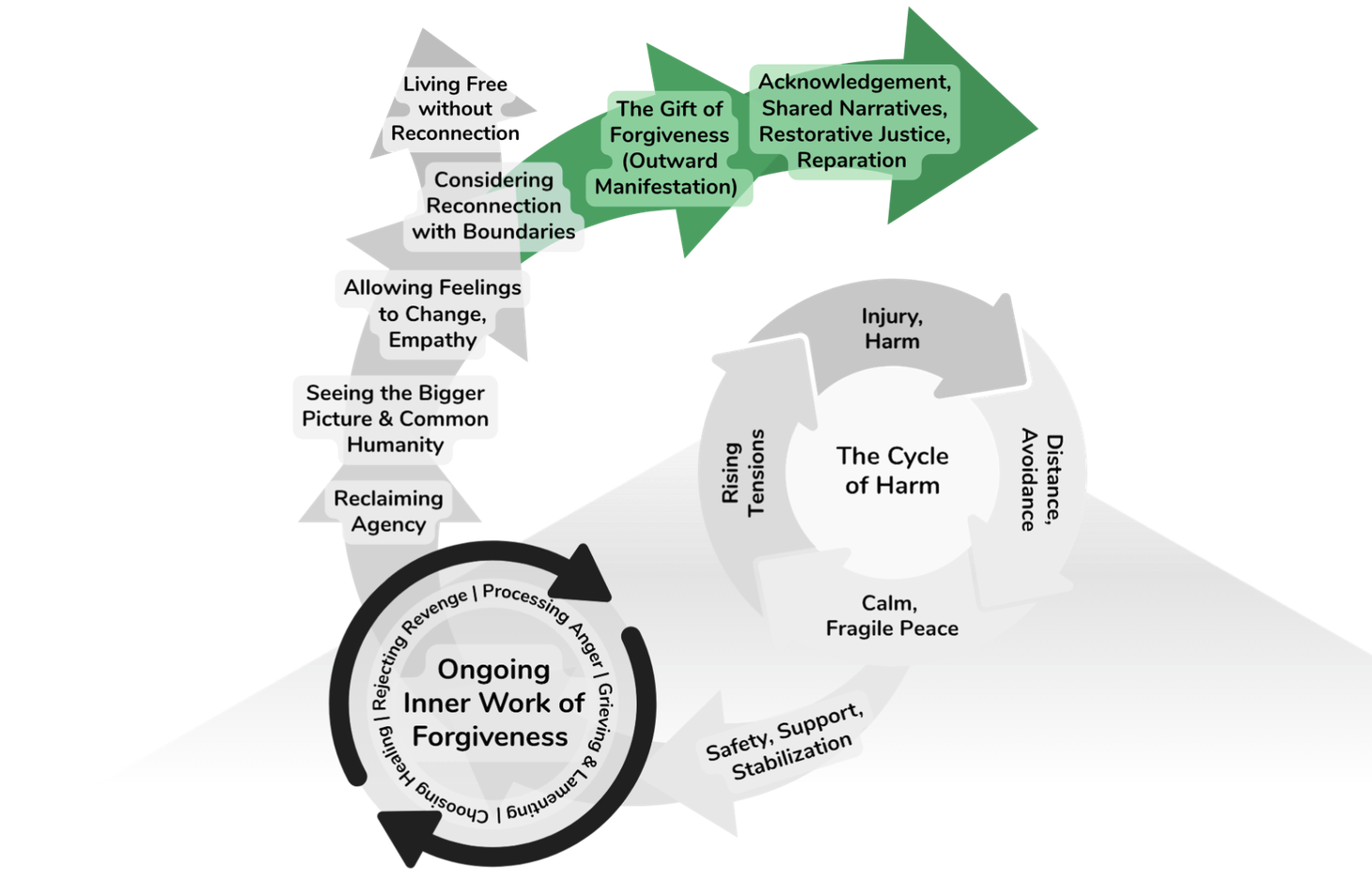
The inner work of forgiveness begins with the survivor’s decision to reject revenge as the defining response to harm. This is not the same as abandoning anger or minimizing injustice. Rather, it is the intentional breaking of the “scripts” that tell us we are forever bound to our pain, or that dignity can only be restored through the suffering of those who harmed us. This rejection of the revenge narrative is itself an act of resistance, reclaiming the survivor’s moral agency and opening space for new futures.
When forgiveness develops into an outward response, it can also become a breaker of cycles in the wider community. This public “gift” of mercy—freely offered, never coerced—has the potential to disrupt entrenched narratives of enmity and fear. Sometimes this gift comes in response to repentance, affirming a process of repair already underway. At other times, it precedes repentance, creating a crack in the wall of defensiveness that allows new relationships and new possibilities to emerge for those beyond the one showing mercy.
Carolyn Yoder captures this shift in vision when she writes, “The traumatized say, ‘Never again.’ … The traumawise say, ‘Never again—to me, to us, or to anyone else.’” Forgiveness is not passivity, but a proactive work to create a safer world for all, breaking the cycles of harm rather than perpetuating them.
But here is where discernment and caution are essential. Mercy that creates space for new beginnings must never come at the expense of truth-telling or the pursuit of restorative and redistributive justice. Without justice, the cycle is not truly broken—it simply shifts form, often reinforcing existing inequalities. The witness of history, including South Africa’s post-apartheid journey, reminds us that forgiveness divorced from justice risks becoming a tool of appeasement rather than liberation and healing.
In its truest form, forgiveness—both in its internal liberation and its outward expression—challenges the systems and stories that keep harm in motion. It clears space for repentance to take root, for communities to imagine new ways of living together, and for the oppressed to claim a future not defined by the wrongs done to them. It is both a deeply personal act of healing and a profoundly political act of resistance.
The Possibility of Reconciliation
Again, forgiveness—even when offered outwardly—does not guarantee reconciliation. These are related but distinct realities. Forgiveness is a release; reconciliation is the rebuilding of a relationship.
However, when survivors freely offer the gift of forgiveness as an act of release—and, at times, invitation—it can be a powerful catalyst. That critical step can create space for perpetrators or members of perpetrator groups to confront the truth, take responsibility, and join in the work of repair. But this space will only lead to reconciliation when it is met with mutual engagement: the acknowledgment of harm, honest truth-telling, repentance, restorative and distributive justice, and tangible acts of reparation.
In personal relationships, this process is challenging. In contexts of systemic injustice—whether apartheid in South Africa, occupation in Palestine, or racial inequities in the United States—it is even more complex. Any attempt to heal relationships while leaving systems of harm intact will reinforce a sense of distrust and ultimately deepen the wounds.
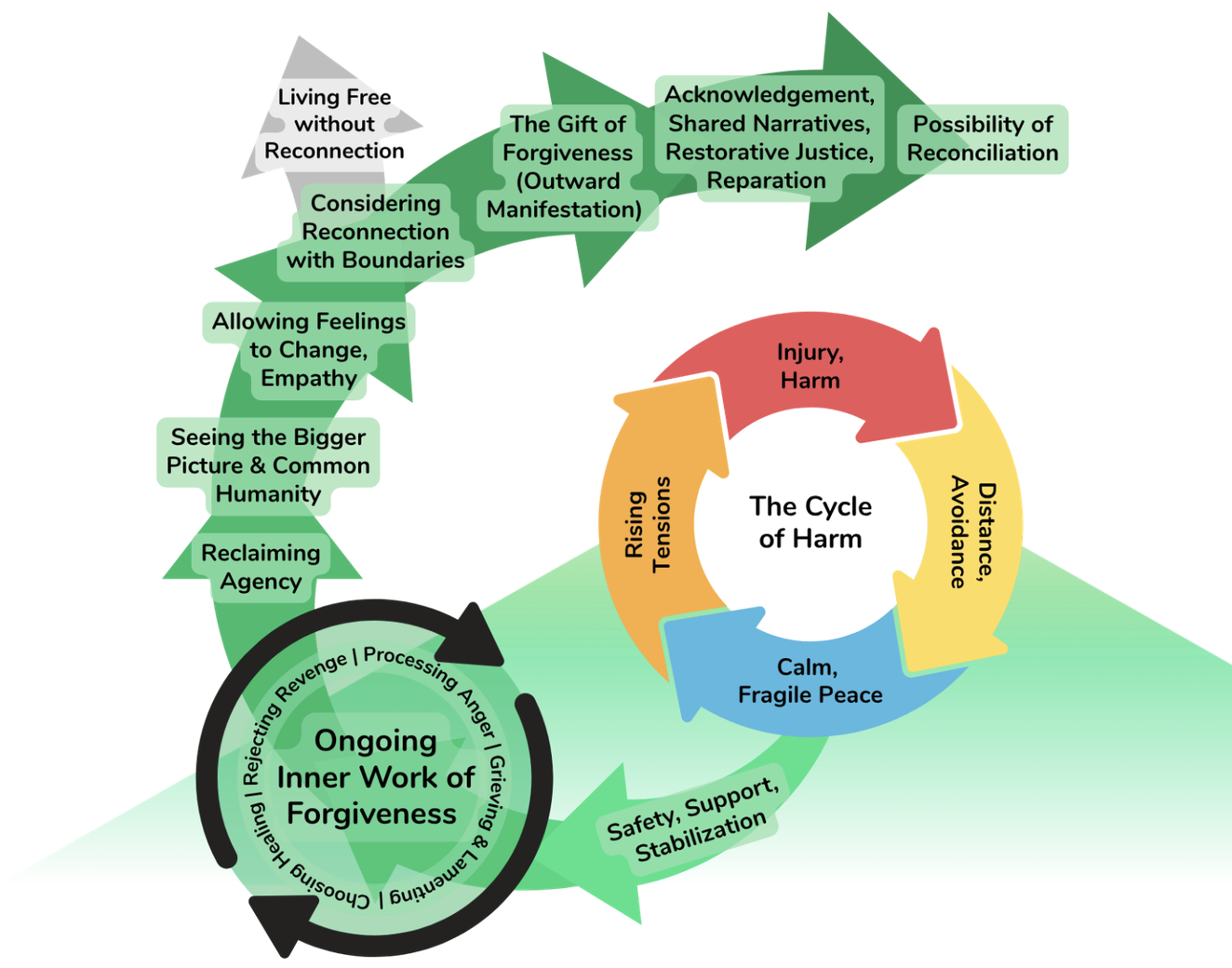
True reconciliation is a long and difficult journey. It requires the courage of survivors, the humility and accountability of those who have caused harm to repent and join in the work for repair, and the shared work of building conditions where trust can grow again. Forgiveness can open the door, but only justice—restorative and redistributive—can keep it open.
Conclusion – A Call to Liberative, Trauma-Informed Forgiveness
Trauma-informed forgiveness reclaims a practice that has been too often distorted. It places survivors at the center, affirms their agency, and refuses to weaponize their healing for the benefit of the powerful. It aligns with Jesus’ teaching—not as a performance for the perpetrator or the public, but as a courageous act of liberation and healing.
In this framework, forgiveness becomes:
An inner liberation from the grip of harm.
A gift that may be offered to the perpetrator—freely and for the purpose of justice, renewed relationships, and the possibility of holistic flourishing.
A breaker of cycles that disrupts both personal and societal patterns of revenge.
A doorway that may open toward repair and reconciliation, but only when joined with truth, restorative and redistributive justice, and the rebuilding of trust.
If the Church is to be a credible witness to the reconciling love of Christ, we must shed colonized narratives of forgiveness and embrace a more liberative vision. We must become communities that protect survivors, confront injustice, and embody the slow, sacred, and courageous work of healing.
Only then will our forgiveness not just speak of peace, but help make it real.
Notes:
See this Peace Catalyst International article, which describes the vision toward which forgiveness is moving: liberation that makes space for justice and the flourishing of all through holistic peace.
From the PCI course, “Healing Harms: From Trauma to Everyday Resilience.”
Examples include Rwandan survivor Immaculée Ilibagiza (Left to Tell, 2006) and testimonies from South Africa’s Truth and Reconciliation Commission. See also Desmond and Mpho Tutu, The Book of Forgiving (2014), and Pumla Gobodo-Madikizela, A Human Being Died That Night (2003).
“Ubuntu” is a Nguni Bantu term often summarized as “I am because we are.” It emphasizes interdependence, dignity, and communal responsibility. In South Africa, it became a guiding ethic for reconciliation under Tutu, though some critics note how it was sometimes invoked to prioritize harmony over justice. See Michael Battle, Ubuntu: I in You and You in Me (New York: Seabury, 2009).
Sandiswa Lerato Kobe, Forgiveness and Ubuntu: A Study of the Theological Contribution of Desmond Tutu (PhD thesis, Vrije Universiteit Amsterdam, 2023), 191–198.
Ibid. Also, Joseph Liechty raises the issue against the TRC is that "it lacked an emphasis on the concepts of justice and repentance," see “Reconciliation theology.”
In “Truth, Justice, and Reconciliation: Judging the Fairness of Amnesty in South Africa,” James L. Gibson argued that sincere apologies would have made TRC amnesty more acceptable to victims, as presented in Cori Wielenga, “Shattered Stories: Healing and Reconciliation in the South African Context.”
Carolyn Yoder, The Little Book of Trauma Healing, p 59.
Restorative justice seeks to repair relationships and address harm through truth-telling, accountability, and healing; redistributive justice ensures the material and structural changes needed for equity and restoration of dignity.