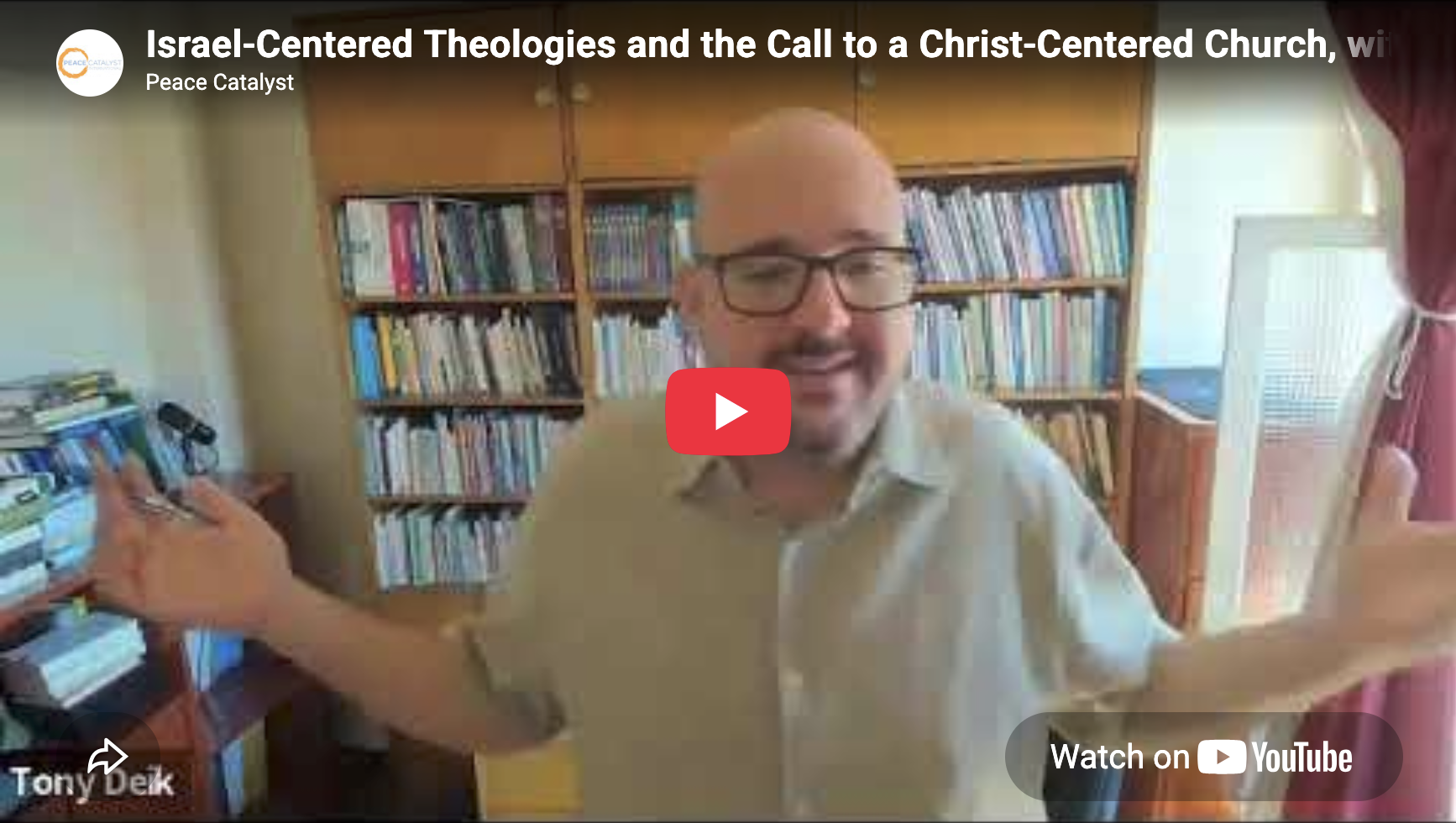
Palestinian theologian Tony Deik challenges Christian Zionism and the weaponization of “biblical chosenness.” The following reflections come after our October 8, 2026 Christian Peacebuilding Network conversation, “Israel-Centered Theologies and the Call to a Christ-Centered Church.” Watch the recording here.
Tony works as the Executive Director of Bethlehem Institute for Peace and Justice, which hosts conferences like Church at the Crossroad and Christ at the Checkpoint that bring together key international and Palestinian voices to engage the Church in the difficult but necessary message of Palestinian Christians.
At a missionary gathering in Germany, Tony Deik joined a prayer group for Israel. He expected to pray for people to experience God’s love. Instead, he found himself among Christians praying for Israel’s military to defeat its enemies.
Years later, aboard the Logos Hope missionary ship, Tony volunteered to lead prayers for Palestine. A colleague objected, and eventually the leadership agreed to close his public prayer table. Afterward, one person offered an explanation Tony would never forget:
“But Brother Tony, Israel is a miracle of God.”
For Tony, a Palestinian Christian born in Jerusalem and raised in Bethlehem, these words were devastating. He thought of the ethnic cleansing of Palestinians, the massacre of his great-aunt, and the expulsion of his grandfather’s family from Nazareth. Christians were calling these things a miracle of God.
Reflecting on this experience during our Christian Peacebuilding Network conversation, Tony asked a question that should unsettle anyone who claims to follow Jesus:
“How can people of goodness, people of light, say such horrific things and defend evil, using the righteous and holy name of our God and the Gospel?”
This is not simply a story about insensitive prayer meetings. It exposes a theological crisis: What happens when people become so convinced that God has chosen their side that they can interpret another people’s suffering as an unfortunate part of God’s plan?
What happens when people become so convinced that God has chosen their side that they can interpret another people’s suffering as an unfortunate part of God’s plan?
The question is urgent. Israel’s genocidal assault on Gaza has brought mass death and devastation, while powerful Western governments continue to provide Israel with diplomatic, political, and military support. Christian Zionism has helped legitimize this support, particularly in the United States, by framing Israel’s contemporary political fortunes through biblical promises. For some Christians, opposing Israel’s actions can appear to mean opposing God.
Theological convictions do not merely shape how we understand political events. They can make political power appear sacred, shield injustice from criticism, and render the suffering of others acceptable—or even necessary.
Tony has spent years confronting Christian convictions that make this possible. He uses the term Israel-centered theologies to describe beliefs that place the modern State of Israel at the center of Christian theological interpretation, including Christian Zionism and other accounts of Israel’s continuing chosenness.
These theologies differ, but Tony identifies a shared danger: the transformation of a particular relationship with God into a claim to privileged status that marginalizes Palestinians and provides religious cover for injustice.
“Christian Zionism and Israel-centered theologies are not only an existential threat to our people, but also a huge distortion to the gospel.”
To understand this distortion, we must look beyond contemporary Israel. Tony’s challenge reaches into the history of both Jewish and Christian interpretations of chosenness—and into a recurring human temptation to justify power over others based on a particular identity.
When repentance becomes another distortion
For centuries, Christians taught that the Church had replaced the Jewish people as God’s covenant people. This teaching, commonly called replacement theology or supercessionism, helped establish a theological environment in which Jewish identity could be understood as rejected by God. It contributed to a long history of Christian antisemitism, persecution, and violence against Jews, culminating in the Holocaust.
Christians must confront this history. Repentance for antisemitism is essential, and Christian theology must reckon honestly with the ways it has dehumanized Jewish people and justified their suffering.
But Tony argues that something has gone wrong when this necessary repentance becomes entangled with an unwillingness to question the modern State of Israel’s claims to divine favor.
He calls this guilt exegesis: interpreting Scripture through Christian guilt in ways that protect Israel-centered theological claims from scrutiny.
“Here I distinguish between guilt and true repentance.”
Guilt can acknowledge past wrongdoing without challenging the assumptions that make present wrongdoing possible. True repentance goes further. It asks how our beliefs shape our actions now: whose suffering we notice, whose claims we accept, and whose lives we are willing to sacrifice to preserve our sense of moral innocence.
Some Christians acknowledge Israel’s oppression of Palestinians and violations of their rights while continuing to grant the modern State of Israel a privileged theological status. Tony sees a fundamental contradiction here. Why should a contemporary state, with its own political history and structures of power, inherit an unquestionable status before God simply because it bears the name Israel?
The modern state of Israel, the Jewish people, and the biblical people of ancient Israel are not interchangeable categories. Nor are Jewish identity, Jewish religious covenantal life, Zionism, and support for Israeli government policy the same thing.
The modern State of Israel, the Jewish people, and the biblical people of ancient Israel are not interchangeable categories.
Rejecting Christian antisemitism does not require granting Israel’s government moral immunity. Supporting Jewish safety does not require endorsing Zionism or the dispossession of Palestinians. Jewish people themselves hold diverse views, including Jewish voices that oppose Zionism and defend Palestinian rights.
We can take Jewish life and history seriously, confront antisemitism, and refuse to make Palestinian suffering the price of Christian repentance. But this requires more than correcting one theological error. It requires confronting the deeper logic that allows religious identity to become a justification for domination.
Chosenness is a calling, not a weapon
At the heart of Tony’s argument is a question: What does it mean to be chosen by God?
The biblical story presents election as a calling with a purpose beyond the chosen community itself. God calls Abraham so that, through him, all the families of the earth will be blessed (Genesis 12:1–3). The prophets repeatedly confront God’s people when they claim a privileged status based on religious identity while neglecting the poor, exploiting the vulnerable, and shedding innocent blood.
Chosenness does not place people beyond moral scrutiny. It carries responsibility.
Yet religious communities repeatedly turn this vocation into something else: evidence that God favors them over others or that their actions enjoy divine approval. A particular relationship with God can become a hierarchy of human worth. An identity can become a license.
Tony describes the danger bluntly:
“This idea of chosenness is like a bomb, right? It’s very dangerous.”
He continues:
“We weaponize the notion of chosenness as Christians, and particularly Western Christians, to colonize the Americas and so on, and subjugate others, and slavery. And now we are giving the permission to the Jews to do the same thing.”
Tony is naming a pattern that Christians should recognize from our own history. European Christians invoked divine election, providence, and biblical promises to justify conquest, colonization, slavery, and the subjugation of Indigenous peoples. They treated their religious identity as evidence of superiority and their political expansion as part of God’s purposes.
The same logic operates when claims about Jewish chosenness are used to grant divine sanction to territorial dispossession, unequal rights, or violence against Palestinians. The problem is not Jewish particularity or attachment to the land; it is the transformation of those commitments into permission to dominate others. When such logic is used to justify Palestinian dispossession or to sanctify military violence, the real-life consequences are devastating.
Jewish people are not uniquely prone to weaponizing religious identity. Our own Christian history makes it clear that no tradition has a monopoly on this temptation. Nor does it mean that Jewish particularity, history, or attachment to the land must be erased. Particularity matters. Communities should be able to sustain their traditions, identities, and relationships with God without being pressured to dissolve into a generic universalism.
The question is what particularity is for.
Does a community’s relationship with God deepen its responsibility toward others, or does it become a reason to claim superiority over them? Does its identity call it to practice justice, or does that identity exempt it from accountability?
Chosenness becomes dangerous when it ceases to be a vocation and becomes divine sanction for our group to wield power. Christians have no grounds for treating this as someone else’s problem. The same logic has repeatedly shaped Christian understandings of election, civilization, mission, and empire. We must confront it wherever it appears—including in our own theology.
From identity to vocation
One way to understand this distinction is through missiologist Paul Hiebert’s concepts of bounded-set and centered-set thinking.
A bounded-set approach focuses on the boundary: Who belongs? Who is inside or outside? Who possesses the right identity, the right beliefs, or the right claim to God’s promises? Identity becomes the primary marker of belonging and legitimacy.

Figure 1. A Bounded Set – Focuses on the perimeter, who is inside vs. who is outside based on identity badges.
A centered-set approach asks a different question: Toward what are we moving? What is shaping our lives? What direction are our commitments taking us?

Figure 2. A Centered Set – Focuses on the core, the direction and movement of our lives toward the way of Jesus.
Applied to our Christian faith, the distinction shifts the emphasis from possessing a privileged identity to embodying the character and way of Jesus. The question is not simply whether we can claim to belong to God’s people, but whether our lives reflect justice, mercy, humility, and love of neighbor and enemy.
This does not make boundaries, identity, tradition, or particularity irrelevant. Rather, a centered-set approach asks what our identity is for. Are our beliefs and commitments drawing us toward the character of Jesus, or are we using them to defend our group from criticism and accountability?
This framework acts as a helpful diagnostic and helps expose the danger in weaponized chosenness. A community can become preoccupied with defending its identity group while ignoring the ethical responsibilities that identity is supposed to entail. It can claim God’s promises while disregarding the people its actions harm.
Reclaiming the Hebrew Scriptures
This understanding is deeply supported in the biblical narrative.
During our conversation, Tony was asked how Christians can continue reading the Hebrew Scriptures (Christian Old Testament) after October 7 and the devastation in Gaza, especially when passages about Israel, land, and divine promise have become sources of anguish.
His answer was direct:
“Christians must not abandon Scripture. They must reclaim it.”
Tony challenges the assumption that the modern State of Israel is simply the continuation of biblical Israel. He points instead to the covenantal life described in the Hebrew Scriptures, in which relationship with God carries ethical obligations toward the vulnerable and the stranger.
The Exodus narrative offers an important starting point. Exodus 12:38 says that a “mixed multitude” went up from Egypt with the Israelites. The text complicates any assumption that the departing community was defined by ancestry alone. The Torah also repeatedly insists that the resident foreigner must be treated justly and included within the community’s ethical obligations (Exodus 12:49; Leviticus 19:33–34; Deuteronomy 10:18–19).
These and similar passages challenge readings that reduce Israel’s identity to ancestry, territory, or an entitlement detached from covenantal responsibility. The biblical story repeatedly connects belonging with obligations toward others.
Tony’s own identity matters here. He does not approach the Hebrew Scriptures as an outsider looking in. He is a Palestinian Christian who understands these texts as part of his own inheritance.
“As a Palestinian, I see the Bible also as my indigenous text. And as a Christian, I see it as my spiritual text.”
Tony’s claim to the Bible as an “indigenous text” is not merely metaphorical; it reflects a tangible historical reality. As Palestinian theologian Mitri Raheb argues in Decolonizing Palestine: The Land, the People, the Bible, the region’s history cannot be reduced to successive empires or to modern political claims. Through centuries of conquest, migration, religious change, and shifting languages and identities, many of the land’s inhabitants remained, even as the societies they belonged to changed.
Modern archaeogenetic research provides another line of evidence for this continuity. A major 2020 study in Cell found that present-day Levantine Arabic-speaking populations, alongside most sampled Jewish populations, share substantial ancestry with populations related to those who lived in the southern Levant during the Bronze Age. This does not mean that any modern population is genetically unchanged or possesses an exclusive claim to the ancient past. It does reinforce the historical depth and interconnectedness of the region’s peoples.
By anchoring his identity in this unbroken history, this Palestinian perspective challenges the assumption that Palestinians are outsiders to the biblical story—people whose presence must be explained in relation to someone else’s promised future. Palestinian Christians have their own histories, identities, and relationships with these Scriptures. Their voices are not incidental to conversations about the Bible and the land. They are part of the living communities through which the biblical story has been read, prayed, and embodied.
Tony does not argue that Jewish people should be prevented from claiming the Hebrew Scriptures or finding meaning in their traditions. He insists that Christians must also be free to read them as Scripture, without turning any interpretation into a weapon against Jews or Palestinians.
“They’re free to claim chosenness. They’re free to claim that they are a continuation of biblical Israel as a Jewish community, as long as they don’t use this to kill us Palestinians.”
The ethical boundary is clear. People can sustain particular identities and make theological claims without receiving permission to dispossess, dominate, or kill others. No interpretation of divine promise should place another people’s dignity beyond consideration.
The question is not who is allowed to find meaning in a sacred text. It is whether our interpretations call us into greater responsibility toward others—or require those others to disappear.
Centering Jesus without weaponizing Jesus
For Christians, Tony’s argument ultimately returns to Jesus—not simply as the lens through which we interpret Scripture, but as the one who truly embodies Israel’s calling and vocation.
Tony points to Jesus’ declaration in John 15: “I am the true vine.” In the Hebrew Scriptures, the vine is an image associated with Israel, the people called to embody God’s purposes in the world. Tony understands Jesus’ words as a decisive theological claim: Jesus is the true Israel, the one who embodies and fulfills Israel’s vocation to live in faithfulness to God and to manifest God’s justice in the world.
This matters because Tony believes some Christians have become so afraid of appearing antisemitic that they are reluctant to center Jesus in their own theology. Instead, they have made the modern State of Israel the controlling reference point for understanding God’s promises.
“We are afraid from centering Jesus now. We think that by centering Jesus, this is antisemitism. So we center Israel now.”
For Tony, centering Jesus has implications for how Christians understand Israel itself. If Jesus is the true Israel—the one who embodies and fulfills Israel’s vocation—then Christians cannot treat the modern State of Israel as though it were simply the biblical people of Israel carried forward into the present, with an unquestionable claim to embody God’s purposes. The biblical language of election and promise must be understood in light of the one Christians confess as their fulfillment, not used to place a contemporary state beyond theological and moral scrutiny.
This also changes what Christians can mean when they call themselves chosen. Tony explains:
“Because of our history of weaponizing chosenness, Christians can only say that we are chosen in the sense of being branches in the true chosen one, in the true elect of God, Jesus.”
The image is crucial. Branches do not possess the vine, stand above other branches, or claim an independent status. They draw their life from the vine. Christian chosenness is therefore not a claim to superiority, privileged access to God, or permission to dominate others. It is a calling to participate in the life and vocation of Jesus.
What are we chosen for?
Tony’s challenge is not simply to change our minds about Israel. It is to examine what our theology is doing in the world.
For Christians, that means refusing to grant the modern State of Israel moral immunity without turning that rejection into hostility toward Jewish people. It means confronting antisemitism without making Palestinian suffering invisible. It means reclaiming the Hebrew Scriptures, listening to Palestinian Christians, and interpreting our faith through the life and way of Jesus.
Above all, examining our theology means asking whether our religious identity is forming us into people who practice justice or giving us reasons to evade it.
Examining our theology means asking whether our religious identity is forming us into people who practice justice or giving us reasons to evade it.
Tony and his colleagues at the Bethlehem Institute for Peace and Justice are asking Christians to take this work seriously. They are seeking opportunities to share Palestinian Christian perspectives in churches, denominational networks, and communities where those voices are rarely heard.
“We want Christians to reclaim their calling as peacemakers rather than warmongers.”
That invitation asks more of us than expressing sympathy from a distance. It asks us to examine the theological assumptions we have inherited, listen to people whose experiences challenge our certainties, and refuse interpretations of Scripture that make another people’s suffering seem necessary for God’s plan.
The danger of chosenness is the temptation to turn particularity into privilege, identity into superiority, and divine promise into permission to dominate. That temptation has shaped Christian history and continues to shape Christian responses to Israel and Palestine.
If chosenness is a calling, it must lead beyond defending our own group toward responsibility, justice, and the flourishing of others. For Christians, that means following Jesus—not as our religious mascot, but as the one who embodies and calls us into God’s work for justice and holistic peace.
What kind of people are we becoming in the name of God?
Watch the conversation with Tony: