We Must Relearn to Welcome the Stranger
While countries resist welcoming immigrants, going so far as establishing detention centers and deporting people to other locations, biblical teachings show Christians must oppose such harsh policies.
“For I was hungry and you gave me food,
I was thirsty and you gave me something to drink,
I was a stranger and you welcomed me.
“But when, God, did we feed you, did we offer you a glass of water? Lord, when did we invite you into our homes, clothing you, sheltering you, without even recognizing your face?”
In Matthew 25, Jesus speaks of how we might identify those who are righteous — who obey divine law, who act honorably and morally — describing them as people who provided the Son of Man with food and drink, clothing and medicine, comfort and hospitality.
But there’s a twist: those welcomed into an eternal life with God did not do this for Jesus. They cared for “the least of these,” whom Jesus calls his siblings. Their compassion was born not out of a desire to get close to a man they felt held power or to obtain accolades; conversely, associating with the poor, the sick, and the stranger likely prompted disdain from their community, possibly pushing them to the margins themselves.
Jesus’ remark, “I was a stranger and you welcomed me,” (Matthew 25:35) calls back to the very first book of the Bible. In Genesis 18, Abraham is enjoying a bit of shade on a hot afternoon when three strangers interrupt his rest. According to the Talmud, Abraham is actually deep in prayer, but rather than continue his conversation with God, he leaps to his feet, running to the strangers to offer them bread and water, imploring them to sit in the shade of the trees . . . all before they’ve spoken a word. Then, Abraham asks his wife Sarah to make cakes (from the good flour!), while telling his servant to prepare a calf (tender and good!) for the visitors to eat, setting out a feast for those he does not know.
One could argue that this is the opposite of Jesus’ story, as the passage begins, “The Lord appeared to Abraham.” But this is the narrator’s point of view, the setting of the scene for those hearing the story. Abraham “look[s] up and saw three men standing near him.” Why, then, provide the choicest of foods to strangers arriving with no apparent purpose?
Culture comes into play: the social contract of the desert required one to offer travelers food and drink, a custom that could mean the difference between life and death. Those welcoming the stranger might very well find themselves the stranger on their next travels, starving and parched, dependent on others to survive another day.
But Abraham and Sarah go above and beyond, baking with their best ingredients, cooking up their most fattened of calves. Perhaps instinct told them they were entertaining angels in their midst. Maybe Abraham had been praying for a sign that God would still carry out his promise, a blessing of land and many descendants.
I see it a little differently. I think the two were acting out of their own lived experience. Abram and Sarai lived in Ur, in Mesopotamia, but set off with Abram’s father to Canaan, only to settle in Haran — still a journey of over 600 miles. Next, God tells the 75-year-old Abram that he needs to take his 65-year-old wife and continue the trek, promising Abram that he will make of him a great nation (Genesis 12:2). Another 600 miles later, they reach Canaan, which the Lord tells Abram is the land he will give his offspring (Genesis 12:7). Abram builds an altar there, but they push deeper, pitching their tent east of Bethel.
Then — imagine! — a famine hits and Abram and Sarai head for Egypt, to reside there as foreigners (Genesis 12:10). We’re not told how much of a rest the couple managed to get in their tent near Bethel, nor how long they stayed in Egypt before they packed up and headed back to “the place where his tent had been at the beginning,” journeying by stages (Genesis 13:4-5), living for a time in the Negev as well.
To live as strangers, in strange lands, is to experience discomfort at best and an outright fear for your own survival at worst. Such experiences likely stirred a sense of empathy in Abraham and Sarah, prompting them to extend kindness to those they believed to be in a similarly precarious situation.
The two are finally blessed with a family, the promised descendants numerous as the stars—but the accompanying promise of land remains out of reach, with God making good on his word that the chosen people of Israel would “be aliens in a land that is not theirs and shall be slaves there, and they shall be oppressed for four hundred years” (Genesis 15:13). God’s insistence on keeping the Hebrew people under Egypt’s harsh rule, far from the safety and security of a land of their own, creates a nation in which remembrance of a time in which they did not have a home of their own remains at the forefront of their minds, where welcome of the stranger and the “alien” are embedded in both the law and the culture:
You shall not oppress a resident alien; you know the heart of an alien, for you were aliens in the land of Egypt (Exodus 23:9)
You shall have one law for the alien and for the native-born, for I am the Lord your God (Leviticus 24:22)
For we are aliens and transients before you, as were all our ancestors (1 Chronicles 29:15)
Hear my prayer, O Lord, and give ear to my cry; do not hold your peace at my tears. For I am your passing guest, an alien, like all my forebears (Psalm 39:12)
And do no wrong or violence to the alien, the orphan, and the widow, or shed innocent blood in this place (Jeremiah 22:3b)
Then I will draw near to you for judgment; I will be swift to bear witness against the sorcerers, against the adulterers, against those who swear falsely, against those who oppress the hired workers in their wages, the widow, and the orphan, against those who thrust aside the alien and do not fear me, says the Lord of hosts (Malachi 3:5)
The Israelites should leave a portion of their harvest in the field for the poor and the alien, should divide up the land and allow the alien to inherit. They must provide the alien with a wage, with opportunities to seek justice. The alien is to be allowed to rest on the Sabbath, should be welcomed into Passover celebrations, permitted to make sacrifices to the Lord—in other words, to participate in the cultural life of the nation. In fact, the alien, under Israelite law, is to be treated just like a member of the nation.
Where have we gone wrong?
As evidenced by Jesus’ own words, the rules against welcoming the stranger did not change when God took on human form and walked among us. Yes, the wording changed—I was a stranger and you welcomed me; love your neighbor as yourself—but the Old Testament makes it clear that “aliens” are the neighbors we are to welcome and love.
Paul continues with this theme, imploring followers of Christ to “extend hospitality to strangers” (Romans 12:13) and reminding us that “Love does no wrong to a neighbor” (Romans 13:10). The Christian community in Colossae is told, “In that renewal there is no longer Greek and Jew, circumcised and uncircumcised, barbarian, Scythian, slave and free; but Christ is all and in all” (Colossians 3:11), building off Paul’s words to the Ephesians, “There is no longer Jew or Greek; there is no longer slave or free; there is no longer male and female, for all of you are one in Christ Jesus” (3:23). Finally, Hebrews hearkens back to the Bible’s first example of hospitality toward strangers, that of Abraham to the three visitors, saying, “Do not neglect to show hospitality to strangers, for by doing that some have entertained angels without knowing it” (13:2).
Yet we live in a world where aliens and strangers, the neighbors we are told to love, are not only not welcomed, but they are pushed aside, rounded up, locked in detainment centers, put on planes carrying them back to unsafe situations. Migrants today are blamed for taking jobs, for increased crime rates, for rising taxes, for housing shortages, for acts of terrorism. This impulse to exclude the stranger is spreading throughout the globe, even as war, economic instability, and climate chaos create more need for people to seek safety away from their homelands.
From Abraham’s display of hospitality toward strangers to Jesus’ assertion that welcoming the stranger is the same as welcoming God, it is clear that Christians are expected to extend a hand to all “aliens” in our midst. This commitment must also extend beyond the individual: Followers of Christ should be willing to stand up to oppressive policies that seek to harm the outsider, to lift our voice in protest when the stranger is facing harm. We must also remember that strength lies in the communal aspect of this work—bringing our faith communities together amplifies our words and actions.
It is time to recommit to welcoming the stranger, to offering hospitality to the foreigner.
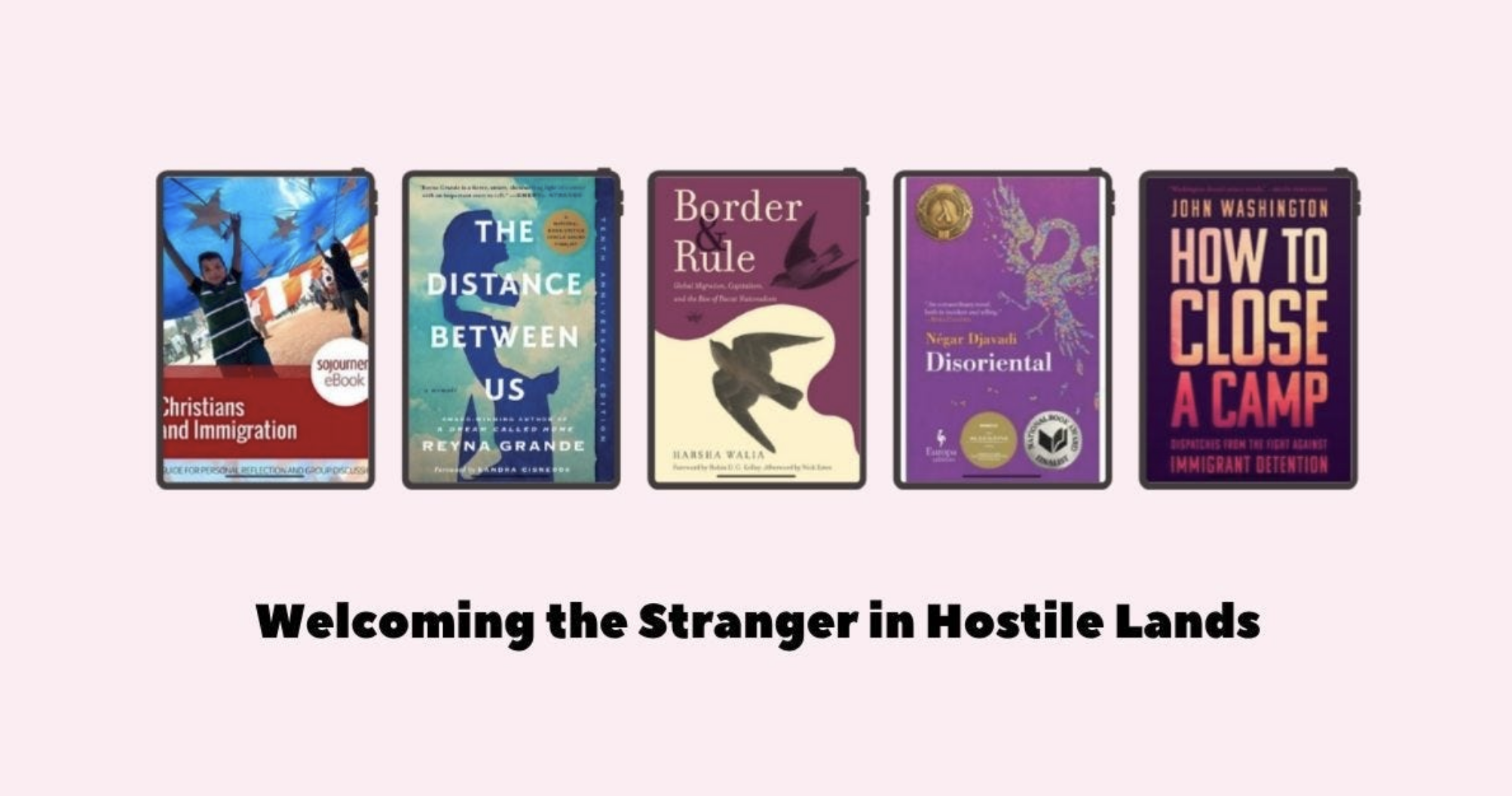
The Graceful Punks Book Club will gather via Google Meet on Saturday, September 26 at 9pm CET/ 3pm ET to discuss global migration, the factors that prompt people to seek new homes, the current response to immigration, and the ways in which Christians might challenge both policies and narratives.
All are welcome! Join us to talk, listen, learn, and grow.
A few books you might consider reading before the September gathering (other suggestions can be found on StoryGraph, where you can join the GPBC challenge):
Christians and Immigration by Sojourners: This $2.99 ebook is a perfect starting point—a collection of current Sojourners Magazine pieces and articles from past decades, is part of a series designed to spark discussion, thought, and action about how to live out God’s call for justice for all our neighbors.
Disoriental by Négar Djavadi: This novel centers on a young woman named Kimiâ, whose family fled Iran after her father spoke out against both the shah and the ayatollah. After settling in Paris, Kimiâ creates a new life for herself in France, yet needs to learn how to move between two cultures—and comes to understand that her new home is not as safe as she might have hoped.
Border and Rule: Global Migration, Capitalism, and the Rise of Racist Nationalism by Harsha Walia: This book disrupts easy explanations for the migrant and refugee crises, instead showing them to be the inevitable outcomes of the conquest, globalization, and climate change that are generating mass dispossession worldwide, mapping the connections between state violence, capitalism, and right-wing nationalism around the world.
The Distance Between Us by Reyna Grande: In this inspirational and unflinchingly honest memoir, acclaimed author Reyna Grande describes her childhood torn between the United States and Mexico, and shines a light on the experiences, fears, and hopes of those who choose to make the harrowing journey across the border.
How to Close a Camp: Dispatches from the Fight Against Immigrant Detention by John Washington: Award-winning journalist and translator John Washington distills strategies and lessons from successful campaigns to close immigration detention centers and block or slow the opening of new ones, drawing on conversations with veteran organizers from the movement.
This blog was originally posted here.

Kirsten Schlewitz is Peace Catalyst Peacebuilding Educator, Digital Activist, Community Builder, and Creation Care Specialist in Belgrade, Serbia. She educates current and future pastors and church leaders on how peacebuilding can bridge their congregations’ spiritual practices, and she also engages in digital ministry to help Christians adopt peacebuilding as a way to live out their faith. Learn more about Kirsten here.