Concrete Ways to Advocate for Peace in Korea
Did you hear the news? Last summer, South Korea’s new President Lee Jae-myung turned off the loudspeakers blasting South Korean propaganda into North Korea to deescalate some tension on the Korean Peninsula. The North reciprocated and turned off their propaganda speakers, too!
In the midst of a world that seems addicted to escalation, this was small, but really good news.
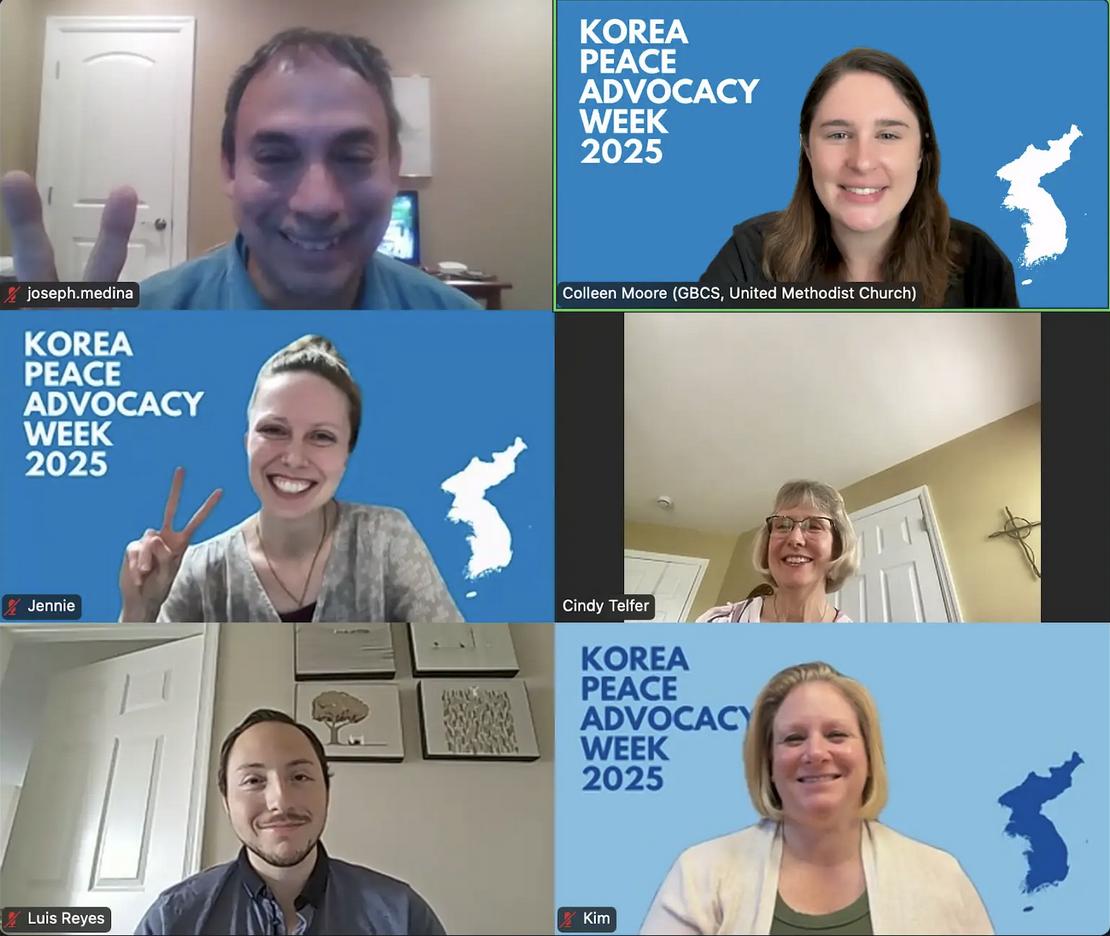
For the past 10 years, from all across the USA, the Korea Peace Now Grassroots Network has organized an annual Korea Peace Advocacy Week, meeting with Congressional staffers seeking their support for a peace agreement to end the Korean War.
Join Korea Peace Advocacy Summer June-August 2026 here
You can also contact the White House and your Representative and Senators to amplify these calls for Korean Peace. Call their offices or follow this link to send a letter in support of peace on the Korean Peninsula.
In our advocacy meetings, we emphasize the narrowing window for diplomacy that currently exists:
1. With a peace-first approach that leads to trust-building and normalizing relations with the DPRK (North Korea), President Trump could end the United States’ longest war – 75 years long and counting (much longer than the war in Afghanistan) – transform the security environment in Northeast Asia – and save money. What a win that would be!
2. President Lee Jae-Myung of South Korea wants to open dialogue with the DPRK. Last year, he made a small step to deescalate tensions on the Korean peninsula by turning off the propaganda speakers, and the government in the North reciprocated! Recently the South Korean government expressed its desire for an end of war declaration. Let’s build on that momentum!
3. The political window of opportunity in the US may close by midterm elections, so it’s time to get that diplomacy going!
The unended Korean War persists because of fear and the fact that our leaders (in the USA, South Korea, and the DPRK) have so far been unable to sustain a de-escalatory spiral, but that can change.
Since the DPRK continues to signal that they will not talk to the US without a shift in the US’s hostile policy, the Trump administration can take action to show goodwill. North Korea has done this historically, unilaterally sending home the remains of fallen US soldiers to show goodwill during talks in 2018.
Some ideas for US actions include:
Lifting sanctions that impact normal civilians in the DPRK
Suspending war drills in Korea – particularly any war drills that simulate offensive maneuvers
Lifting the travel ban on American citizens traveling to the DPRK
Openly declaring our intent to end the 75 year-long Korean War
Ending a war as entrenched as the one on the Korean Peninsula requires political support. 70% of Americans support renewed dialogue between our nations (2025 AFSC poll), but we need more of us to directly ask our leaders for a peace agreement to end the Korean War.
American friends, would you amplify the call for peace in Korea?
Call your elected House Representative and ask them to co-sponsor the Peace on the Korean Peninsula Act (H.R. 1841).
Call your Senators and ask them to introduce a Senate version of the Peace on the Korean Peninsula Act (H.R. 1841).
Share this post

Jennie Telfer is a PCI Program Director in Taebaek, South Korea. Born in the USA but raised in Europe and Africa, Jennie’s professional career has taken her around the world providing social services and advocating for populations impacted by trauma, injustice, and war. Her mission is to speak peace and joy into systems and situations of conflict to see them transformed. In solidarity with Koreans and Korean organizations, she currently provides peace education, advocates to end the Korean War, and mobilizes people for peacebuilding. Learn more about Jennie here.