The Church Taught Me to Love My Enemies—Then Blessed Me as I Went to War
By Jason Burkett, US Army veteran and friend of Peace Catalyst
The views and experiences expressed here are the author’s own.
I joined the Army twice. The first time (1989-1996), I was a junior in high school, and it was the summer before my senior year. My dad was a truck driver, my mom was a teacher, and we didn't have much money. I knew my parents couldn't afford to send both my sister and me to college, and back in the late '80s and early '90s, it was all anyone talked about: college, college, college. My dad had served in Vietnam. And my grandfather — my mom's father — served thirty years in the Marine Corps. So joining felt like a family thing to do. I signed the papers in what's called the Delayed Entry Program and chose the Infantry, even though my test scores were high enough that I could have done pretty much anything in the Army. I wanted to be like my dad.
Seven years later, I was asked to leave for being a knucklehead. I went back to California, started college, met my wife, and had three kids. In 2006, my family and I were living in Missouri, and I was working as a Local Veterans Employment Representative for the state of Missouri — helping veterans find jobs — but the benefits for a family of five ran about $600 a month. I couldn't afford it. Then I started getting emails from the military: We're looking for veterans. I already knew what was on the other side of that door. Great medical, great dental, housing, guaranteed promotions, and pay raises. And bonuses. My first reenlistment bonus was around $25,000. When I was deployed in Afghanistan a few years later, I reenlisted again while I was in-country — that bonus was tax-free. Some Green Beret guys were getting $100,000 or more to stay in. The military was the best option for my family, full stop.
But the second time I joined (2006-2019), I was also a Christian. And that added another layer to why I went back. During my first enlistment, I was in a dark place. I went to see chaplains — more than once. Not one of them ever asked me about following Jesus, about the way of Jesus, about anything that actually touched the soul of what I was going through. I knew that going back in, I could be something different for soldiers. I deliberately chose to enlist and work my way to becoming a non-commissioned officer (NCO) rather than an officer because NCOs are always in charge of lower enlisted guys. Always. I wanted to be present with them, to be somebody they could actually talk to about life. That was real to me.
What I never heard — not once — was anyone suggesting that returning to the military might not be the way of the church. I had never heard of conscientious objectors, and I now see that Scripture calls us to love and nonviolence.
The Ecosystem Nobody Named
Nobody in my church ever stood at a pulpit and explicitly said, kill for your country. Still, the subtle messages and cultural practices made many feel it was acceptable.
Here's what was said, and what it added up to.
After 9/11, the church my family was a part of wanted all veterans to attend a special service in dress uniform. Something about it didn't sit right with me, but they did it anyway — rows of uniforms in the sanctuary, the whole thing. Around the same time, I remember hearing about a top Pentagon general, one of the original Delta Force guys, speaking at a church in his uniform. His message was deeply Islamophobic. The Army investigated him for it. The church embraced him.
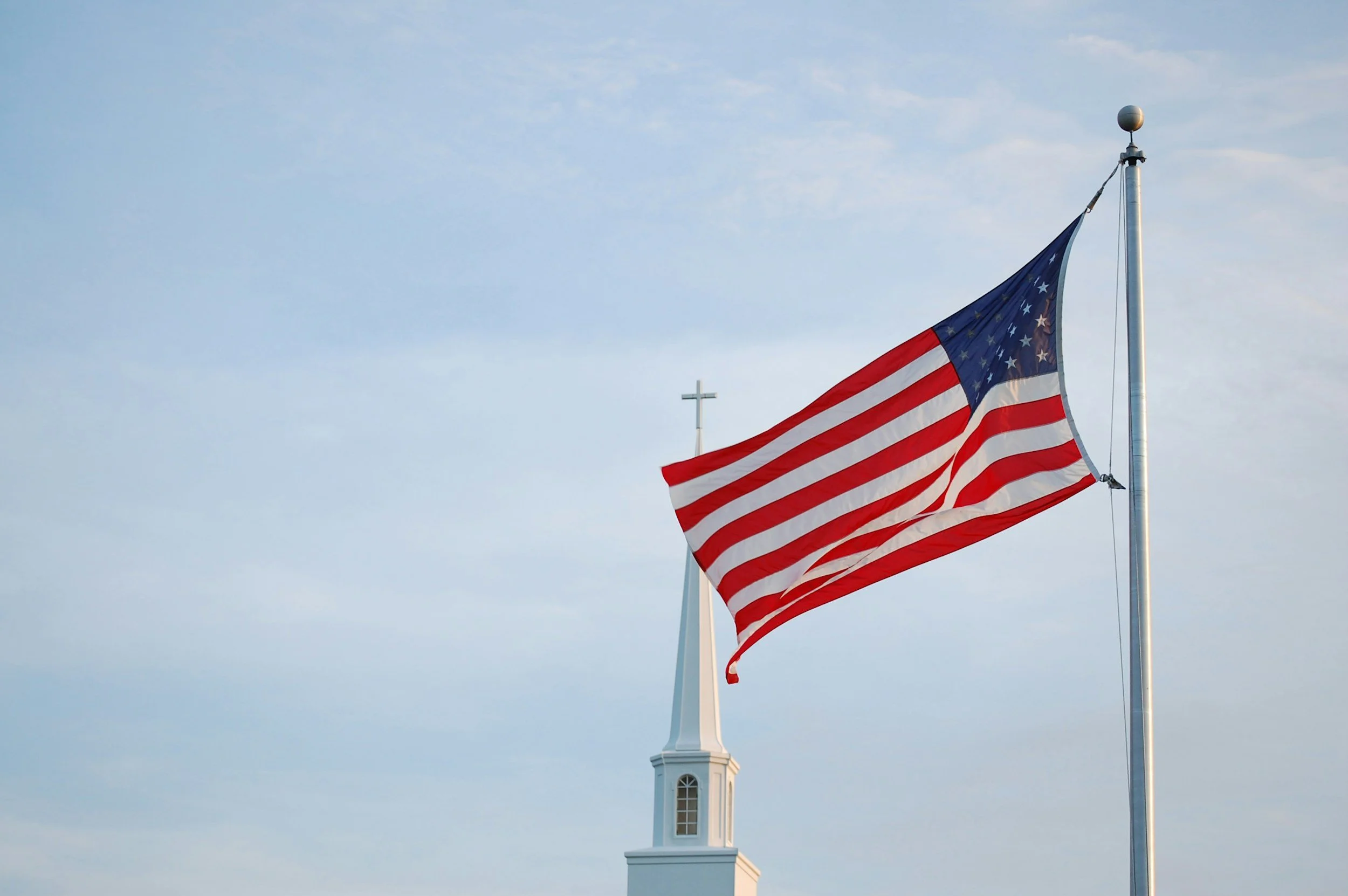
There was also an Assemblies of God church in Springfield, Missouri — the largest in the denomination's headquarters city — that put on the biggest Fourth of July celebration in town every year. Fireworks, carnival atmosphere, the whole production. And a message. Everybody came, because it was the best patriotic event in the area. Done by the church. Christianity and nationalism fused seamlessly.
More recently, Pete Hegseth posts Bible verses layered over images of fighter planes, helicopters, and naval warships. I'm harder on him than most because he's a professed Christian. And I keep asking: where does Jesus say to go to war?
But back to the ecosystem. You could map it like this:
First, Romans 13 — support your government.
Second, Just War framing. Most Christians have probably never actually read what Augustine wrote about just war, what criteria he set down, what he required for a war to be legitimate. But the government uses the language. It calls something a "just war," and since Romans 13 says support your governing authorities, Christians accept the government's word as theological validation.
Third, the fear and othering of the enemy — Islamophobia after 9/11, the axis of evil, us versus them.
Fourth, the public celebration of veterans. Dress uniforms in the sanctuary. Special services. Honor and applause.
None of those four things individually says go kill the enemy. But together, they create a moral ecosystem that points in one direction, leaving us at a moral crossroads that demands urgent reflection and action.
I remember an instructor in an Army schoolhouse — I was transitioning from a combat arms job to one working with civilian populations on the battlefield — telling our class flatly: “Sometimes you might have to compromise your morals.” Another soldier and I looked at each other, as if the instructor were insane. But now, when I think about it honestly, the instructor was telling the truth. If the church taught me not to kill, and then I killed — I compromised my morals. The instructor said aloud what the church would never say.
Mark Twain understood this. His "War Prayer" is not a Christian text, but it is a prophetic one. The spoken prayer asks God to grant our soldiers safety and victory in battle. The unspoken prayer — the one nobody says out loud — asks God to help us create widows, orphans, and broken bodies on the other side. We pray the first prayer constantly. We never reckon with the second. The church sends its sons and daughters off to war, cheering and waving flags, without ever sitting with the full weight of what it is actually asking them to do.
I'll say one more thing about the enemy question, because it mattered to my own conscience. I heard "love your enemy" in church my whole Christian life. But somehow that commandment applied to the difficult neighbor, the difficult coworker, the person who wronged me down the street. It did not apply to the enemy in Afghanistan or Iraq. Because those were our nation's enemies, not my enemies. The distinction was never made explicit. Nobody explained why it was fine to exempt the Afghans or Iraqis. It was just assumed.
Hebrews 1:3 says Jesus is the exact imprint of God's nature. At the Transfiguration, God speaks to the disciples about his Son and says, “Listen to him.” So I go back to the Sermon on the Mount — the clearest, most sustained public teaching Jesus ever gave. And nowhere, not in a single line, does Jesus tell his followers to use a sword. What he does say is that those who live by the sword will die by it.
What It Did to Us
I never shot a person with my own weapon, and I’m grateful for that. But I did call in airstrikes. I watched A-10s do gun runs on people through a video screen. And in those moments — I'll be honest — the response was hell yeah. That's the adrenaline talking. That's your body in full fight-or-flight, flooded, operating at a level you've been trained for years to sustain.
What I've come to understand is that the military trains your body to run at maximum adrenaline. In training, in deployment, in combat — that's your baseline. Your nervous system recalibrates around it. And when you leave, your body doesn't know how to operate at normal levels. You've been addicted to adrenaline without anyone ever calling it that. I would still love to jump out of airplanes. That's not a hobby. That's my body chasing what it's used to.
When the adrenaline is gone, and the uniform is hung up, and you're back in a suburb somewhere, all the things your adrenaline carried you through start to surface differently. The video screen moments. The gun run moments. The faces you can imagine, but try not to. The men you never knew who had wives, children, families — people who will now live without them because of a decision made through a camera feed.
I've lost between ten and fifteen friends to suicide since Afghanistan. One of them murdered his wife before he died. I've had to call the police on friends I thought were going to harm themselves. I didn't care if they hated me for it. I made the call.
I had one panic attack. I was with friends when it happened, and I was grateful for that. Because in the middle of it, I kept thinking: my friends who went through the same things I did and don't have community around them, don't have faith holding them — no wonder the suicide number is so high.
What I was experiencing has a name. It's called moral injury. I didn't learn that term until after I left the Army. During service, mental health wasn't something you talked about. But moral injury is different from PTSD, even though they overlap. PTSD is the wound left by what happened to you. Moral injury is the wound left by what you did, or what was done in your name, or what you watched happen and couldn't stop— the gap between the person you believed yourself to be and the actions you took or witnessed. When a church teaches you that killing is wrong, that human beings are made in the image of God, that Jesus commands you to love your enemy — and then that same church blesses you as you do the opposite — the contradiction doesn't dissolve in combat. It waits. And it surfaces later, when the adrenaline is gone, and you're alone at 2 in the morning, and you finally have the space to think.
I learned about trauma and moral injury through a program called Reboot Recovery, started near Fort Campbell, Kentucky, which saw what was happening to soldiers and decided to do something about it. At the time I went through it, during the period when "22 veterans a day" was in the national conversation, they had not lost a single veteran to suicide who completed their course. A local church ran the program I attended in Colorado Springs. But it was run as a separate evening class — disconnected from the congregation. The church body at large never had to look at it directly.
That's part of the problem.
What the Church Owes
I've heard theologians I deeply respect make the theological case for Christian nonviolence with great care and great learning. And they're right. But none of them has ever walked a day in my boots. The argument for nonviolence needs to come from people who know what violence actually costs, from the inside — not just from scholars who've read about it. Veterans need to be the primary voices calling the church to account here. We know what the church's silence bought.
So what does the church actually owe? What does repentance look like?
George Kalantzis, a professor at Wheaton who wrote Caesar and the Lamb, made a proposal that has stayed with me: the church needs the services of repentance and reconciliation when soldiers come home. Not soldiers repenting. The church repenting for building the ecosystem that sent its sons and daughters to war without ever honestly grappling with what it was asking them to do.
Veterans Day should be that day. Memorial Day should be that day. Not celebrations of military service inside the sanctuary. Days of honest reckoning. The Church asking for forgiveness from the people it sent.
But repentance without change isn't repentance. It's sentiment. So alongside those services, the church needs to do the actual theological work it skipped: go back to the early church fathers and what they taught about war and violence. Kalantzis writes about what happened to Roman soldiers who converted to Christianity — Cornelius the centurion, who, as a senior officer, was likely a kind of pagan priest for his soldiers, may have been martyred after his conversion because he could no longer perform those rites. Saint George, whose cross flies on the flag of England, lost his life because he refused to pick up the sword. And yet the United States Army has a Military Order of Saint George — an award given to tankers and cavalry soldiers. We have taken martyrs who died for refusing violence and turned them into symbols of military honor. The church has done the same thing with its theology, and it needs to undo that work honestly.
The church also needs to stop looking away from the economics. Most people who join the military aren't driven by ideology. They're driven by need. Education, healthcare, a reliable paycheck, the chance to build generational wealth through VA home loans, and GI Bill benefits they can pass to their children. The military is, for many families, the best available option. If the church wants to stop feeding people into that pipeline without moral formation or honest theological preparation, it needs to advocate for the economic conditions that would make other paths viable — better wages, better housing, better healthcare, national service alternatives that offer comparable benefits without requiring combat. Otherwise, the pipeline continues, and the moral injury continues with it, and the church will have more veteran deaths on its conscience.
The American evangelical church introduced me to Jesus in 1998, and I have followed Him ever since. I'm not writing this out of bitterness. I'm writing it because the church taught me to take Scripture seriously, and Scripture will not let me stay quiet about this.
Jesus does not make this tension hard to understand. The Sermon on the Mount is not a private spiritual ideal. It is a public ethic. Enemy-love, mercy, a refusal to retaliate — these are not optional for disciples. They are the character of God made visible in human lives. A passport is not a creed. A flag is not a sacrament. The church cannot keep baptizing national loyalty and calling it discipleship.
The age of excuses is over. The church must answer for what it taught, what it blessed, and what it broke.
And I should know. I was one of the things it broke.