Safia Lamdaghri, a Danish student completing her masters in Global and Development Studies at Roskilde University, is currently an intern with PCI in Bosnia and Herzegovina. The following is a reflection processing BiH’s war-torn history and complex context as a visitor and Danish citizen. Learn more about our Bosnia internships here.
I am often asked, “How are you processing things?”, “How are you feeling?”, “How are you doing?”
The questions seem simple enough, yet I struggle to answer them.
It makes me wonder: What does it mean to process things? Do I have to be aware of the process itself, of how my body absorbs information and responds to it? But what happens when the feeling itself is unfamiliar? When it falls outside my experience and beyond my understanding?
It seems I only know how to understand something after I have rationalized it.
Let me take a moment and look back on my life in Denmark. A small country located in Northern Europe. A country often described as one of the happiest in the world. A country that for many is the ideal society, a utopia to strive for.
In this environment, I was surrounded by people who regarded the struggles of the non-Western World with a quiet sense of superiority, as though poverty, conflict, and instability were natural conditions rather than the result of complex historical and political forces. All these around me were people who had not experienced an ounce of what it is like to be the target of unimaginable terror, war, internal conflict, atrocities, or crimes against humanity. This is not to dismiss the hardships endured by Danes during the German occupation in World War 2. However, the victims of that era are not the faces that shape Denmark’s public image today.
Denmark today is filled with flowery narratives of how great the West is and how actively Denmark contributes to making the world a better place through its support of NATO and the United States in their military operations. People are free here. People are happy here. And according to many, it is thanks to the absence of communism and religion, and the rise of democracy. This reminds me of the book Society Without God by Phil Zuckerman, an American sociologist who makes a similar argument.
Anyway, if it is not already apparent, Denmark is a peaceful country, with some of its biggest worries being the number of immigrants arriving in the country. Coming from such a background, my first reaction to reading the memories of victims of the Bosnian War was literally just sadness.
To be quite honest, prior to visiting the museums, I had already listened to a firsthand account from a Bosnian survivor of the war a year earlier. Back then, I was completely stunned. I was speechless, and I was ashamed of the privileged life I lead. Never in my wildest dreams could I have imagined enduring what they endured.
The person whose story I heard spoke of witnessing his sister being shot before his eyes. And his uncle who was used as a human shield by the Croatian army. He described living through months of starvation and watching his grandfather risk his life every single day to bring some water, a basic human need and right. He recounted how he, as a 6-year-old, eventually suffered a severe injury that required surgery, which was performed underground under poor conditions without the proper medical equipment.
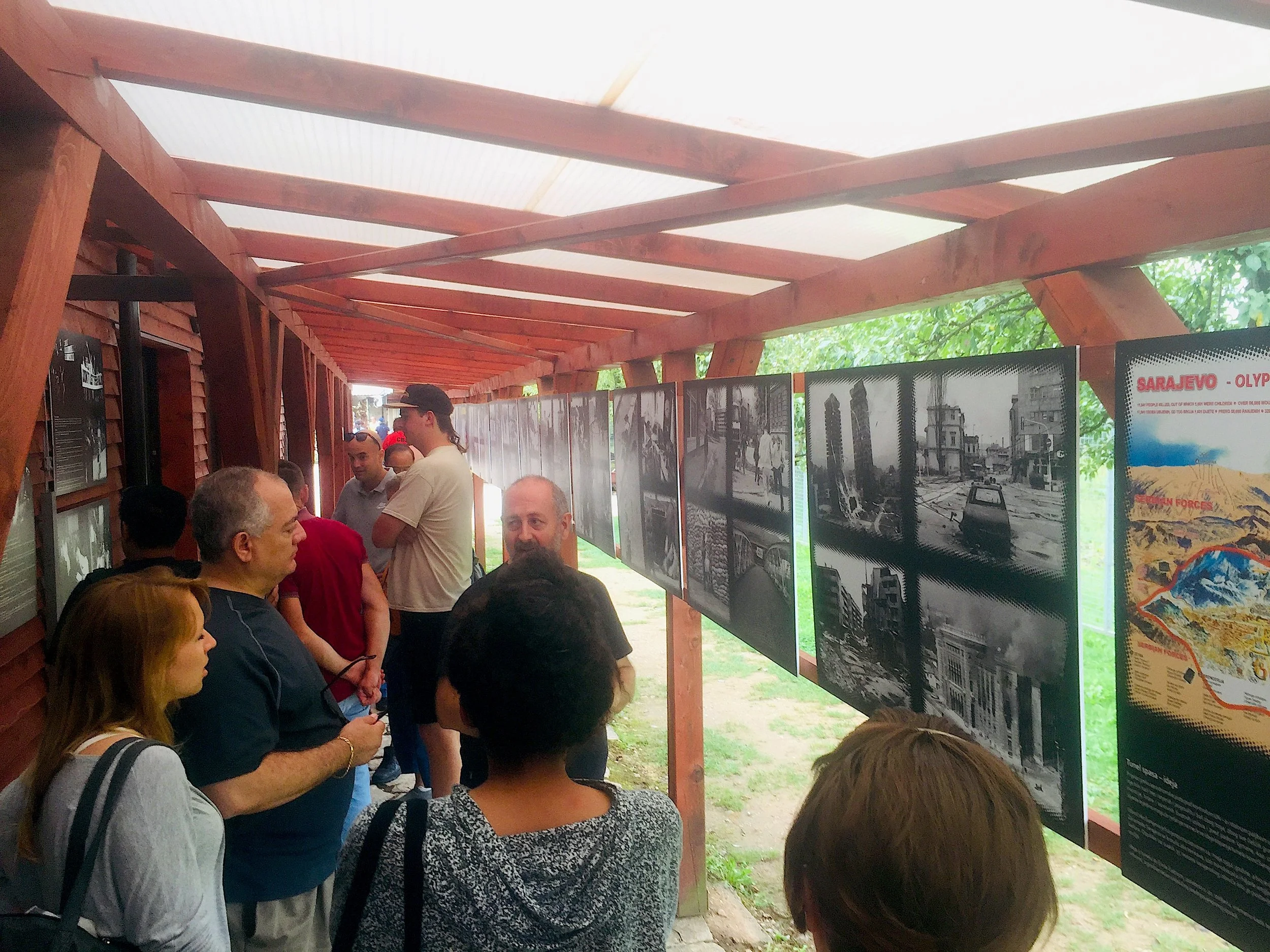
Having already been shaken by this firsthand story, which described a reality completely foreign and unimaginable to me, and which revealed the inhumanity and horror of human actions, I responded differently when I learned about people’s stories as I visited museums in BiH. This time, I found myself imagining their reality as my own.
While I was reading the stories of survivors in the museums, I placed myself in their shoes. I imagined having to say goodbye to my sister without knowing whether I would ever see her again, only to learn that I never would. I imagined living with the regret of not having given her one last tight hug and telling her I love her. I immersed myself in the reality of facing a near-death experience every time I left for work or searched for bread, water, or humanitarian aid. I imagined an everyday life consumed and overshadowed by fear and uncertainty, where death loomed in every corner.
And finally, I was ashamed. I was ashamed that I cannot truly imagine what it means to survive on canned food for years, when even that would be a fortunate scenario.
Honestly, I don’t know what to say.
As I mentioned in the beginning, unfamiliar feelings were stirred within me. Unfamiliar means difficult to imagine, difficult to rationalize, and even difficult to comprehend. And honestly, thinking about this statement I just made makes me sick to my stomach: difficult to rationalize and comprehend. This is proof of the privilege I have comfortably enjoyed in my little safe space in Denmark, where everything is “objectively” evaluated and rationalized. Something only people who have not experienced terror and war can afford to do. A luxury reserved for people whose reality has remained far removed from the suffering and experiences of others.
War, survival and terror have nothing to do with rationality. They are all feelings. Feelings that one cannot truly relate to unless they have been lived.
Perhaps this is my way of processing. Not by finding the right words, but by sitting with the discomfort of realizing that some experiences cannot be fully understood from a distance. And realizing that processing and understanding are not always about making sense of something. They’re more about acknowledging it happened, that it matters, and that my understanding will always remain incomplete.
I will continue to seek knowledge and listen to the voices of the forgotten.