
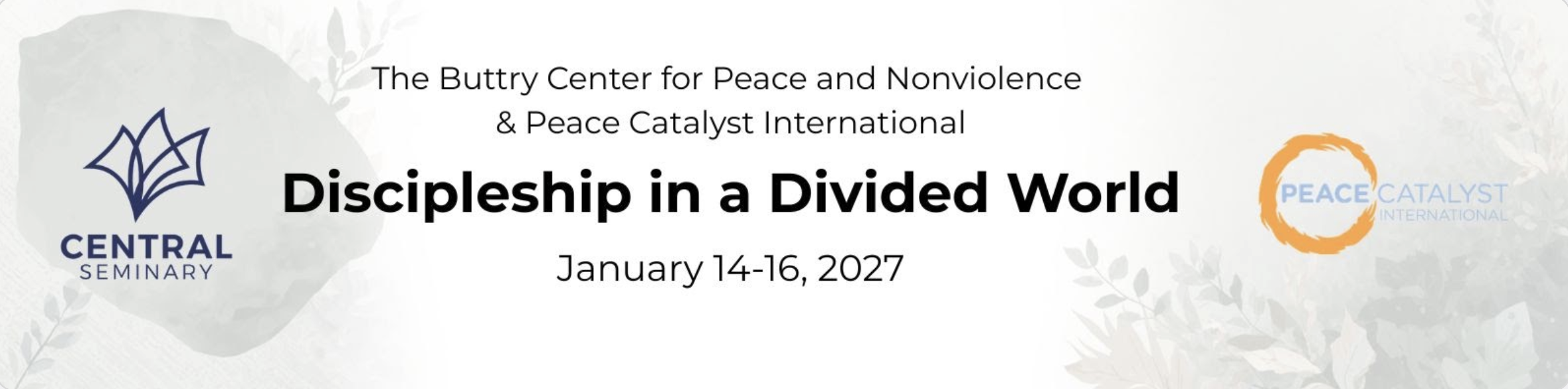
If Jesus consistently forms people toward humility and love of neighbors and enemies, why does Christianity so often form people toward boundary protection instead?
Across history, Christian understandings of faith, identity, sin, power, mission, salvation, and discipleship have been shaped not only by Scripture, but also by culture, institutions, and proximity to power. This intensive invites participants into a shared process of examining those inheritances and exploring what it might mean to be re-formed by Jesus and God’s reign of holistic peace.
Rather than relying on lectures, this intensive uses interactive and experiential learning methods that engage participants through activities, reflection, dialogue, storytelling, theological exploration, and practical application. Together, participants will explore how Christian formation happens, why certain theological instincts persist, and what kinds of practices, habits, and skills cultivate peace, justice, healing, and reconciling love.
Participants will engage themes including:
Conflict as Holy Ground: From Comfort to Courageous Discipleship
A Peace Paradigm: From Christianity to God’s Reign of Shalom
Faith & Identity Reoriented: From Boundaries to Christlike Fidelity
The Sin Matrix: From Guilt and Blame to Collective Healing
Christlike Power: From Triumphalism to Resistance
Forgiveness & Repentance: From Tokenism to Transformation
Peacebuilding Atonement: From Escapism to Liberation
Good News for All: From Theology to Solidarity
A Healing Journey: From Quick Fixes to Sustained Peacebuilding
This intensive is not designed to tell participants what to think. It is designed to help participants examine how they came to think the way they do—and to explore how Christian formation might reflect the liberating, healing, and reconciling way of Jesus.
Participants will also receive access to open-source curriculum materials and facilitation resources for continued learning and adaptation within their own communities.
WHO IS THIS FOR?
This intensive is for Christians who sense that many of the challenges facing the Church today run deeper than disagreements over a few theological positions or ministry practices. Together, we will explore how faith is shaped at the level of stories, assumptions, intuitions, identity, and imagination—and what it might mean to be re-formed by the way of Jesus.
You will find this intensive particularly valuable if:
You are concerned about the state of Christianity and seeking pathways for change.
Many Christians are troubled by the growing influence of Christian nationalism, polarization, exclusion, and power-seeking within the Church. If you are looking for ways to engage these realities constructively—without simply condemning whole groups of people—this intensive offers frameworks, language, and experiential tools for opening difficult conversations in ways that are thoughtful, pastoral, and transformative.You sense something is wrong, but are unsure where to begin.
Many pastors, ministry leaders, and thoughtful Christians recognize tensions between the way of Jesus and some of the assumptions they have inherited, yet struggle to identify what lies beneath those tensions. This intensive helps participants examine the deeper narratives and frameworks that shape Christian faith and practice, offering greater clarity and practical next steps for faithful discipleship and formation.You care about peacebuilding, reconciliation, and justice, but are cautious or skeptical.
You do not need to arrive convinced of every premise explored in this intensive. Honest questions, concerns, and critiques are welcome. The workshop is designed as a shared learning environment rather than a space for ideological conformity. Participants are invited to engage critically, reflect deeply, and wrestle openly with the material and with one another.You form others in faith.
Pastors, educators, small-group leaders, peacebuilders, chaplains, activists, and organizational leaders will find practical value in the curriculum’s experiential learning approach. Participants will receive access to open-source materials and facilitation resources that can be adapted within churches, classrooms, organizations, and community settings.
WHAT MAKES THIS DIFFERENT?
Many Christian learning spaces focus primarily on ideas, beliefs, or ministry strategies. This intensive works at the level of imagination, instinct, conditioning, and narrative.
Through interactive and experiential learning, participants will engage interconnected session themes in ways designed to create lasting insight and transformation.
PRACTICAL DETAILS
Logistics
Dates: January 14-16, 2027
Location: Buttry Center for Peace & Nonviolence (Central Seminary), Overland Park, KS
Expected Capacity: approximately 20–25 participants
Sessions will take place on the seminary campus in an interactive learning space.
Schedule
Participants are expected to attend the full three-day intensive, held Thursday January 14–Saturday January 16, with sessions running approximately 9:00am – 5:00pm each day. The program includes experiential workshops, small-group discussions, guided reflection, networking, and a closing session focused on integration and next steps.
Participants traveling from a distance should plan to arrive on Wednesday, January 13, and depart after sessions finish on Saturday, January 16.
Lodging
Participants are responsible for arranging and covering their own lodging.
The Buttry Center has secured a group rate at a nearby hotel about 1.5 miles from the seminary. Booking information will be provided upon acceptance.
Meals
Lunches, refreshments, coffee, and snacks during the intensive will be provided as part of registration.
The recommended hotel includes breakfast and a complimentary evening reception with light food and beverages, and additional dining options are available nearby.
Registration Fee
A $50 registration fee serves both to help offset event costs and to ensure committed participation, as space will be limited.
Travel
Participants are responsible for their own travel expenses to and from the event.
FACILITATOR

Bryan Carey is a peacebuilding consultant, conflict transformation trainer, and Director of International Peacebuilding at Peace Catalyst International. Bryan and his family have lived in Sarajevo, Bosnia & Herzegovina since 2017, where they have been learning alongside and supporting the work of Muslim, Catholic, and Orthodox peacebuilders in a society still living with the legacy of violent conflict.
Over nearly two decades of cross-cultural work, Bryan has partnered with churches, pastors, community leaders, and peacebuilders in contexts including Peru, Zambia, the United States, the Balkans, Northern Ireland, East Africa, the Middle East, and Ukraine. His work explores how Christians can become active participants in healing fractured relationships, addressing injustice, and contributing to peace within and beyond their own communities.
While studying justice, peacebuilding, and conflict transformation at Candler School of Theology at Emory University, Bryan became increasingly interested in a deeper question: Why do forms of Christianity that proclaim the Prince of Peace so often produce fear, exclusion, polarization, or the pursuit of power? That question has shaped much of his work over the past decade.
Drawing on theology, conflict transformation, trauma healing, and experiential education, Bryan has spent the past seven years developing interactive learning experiences that help Christians examine inherited theological assumptions about faith, power, identity, mission, and discipleship. Rather than relying on lectures, these workshops invite participants to discover, reflect, and wrestle together with how Christian formation shapes the ways we see, respond, and live. Versions of this curriculum have been facilitated with pastors, peacebuilders, students, and ministry leaders across Northern Ireland, East Africa, the Balkans, the United States, and the Middle East, and continue to be refined through diverse international partnerships. Bryan’s hope is not simply to offer new theological ideas, but to help cultivate forms of Christian discipleship that more faithfully embody Jesus’ way of peace, justice, and reconciling love.
HAVE FURTHER QUESTIONS?
Contact Ruth Rosell at rrosell@cbts.edu or Bryan Carey at bryan.carey@peacecatalyst.org