A Shalom-Centered Worldview “Belief Tree”
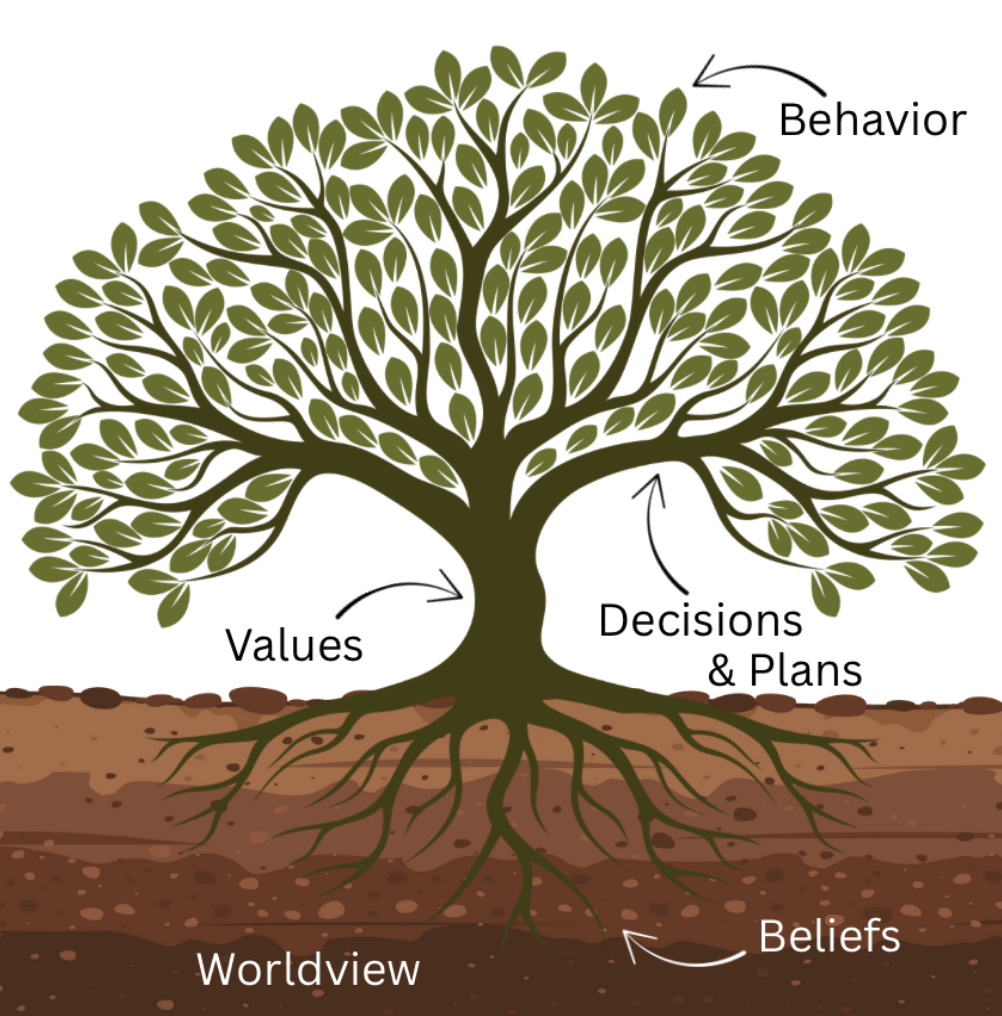
Reframing the “Belief Tree” for a Shalom-Centered Worldview
The “Belief Tree” diagram (above) is a helpful visual tool for exploring how our worldview influences our beliefs, values, decisions, and behaviors. (See the footnote at the end of this post for more on the concept of a “belief tree.”) By visualizing these connections, we can better understand the relationship between what we believe at the deepest level and the “fruit” that our lives produce.
While this concept has been used in various contexts, including by some Christian organizations, this adaptation reflects a worldview grounded in the biblical concept of shalom/eirene — holistic, just peace. Shalom is a concept that involves God as actively working to heal all things, establishing flourishing relationships among all people and creation. A shalom-centered worldview offers an alternative "belief tree,” inspiring theological beliefs, values, and actions that align with peacebuilding, justice, and reconciliation.
The Soil: A Worldview Grounded in Shalom
At the foundation of the tree is the worldview, the unseen soil that nourishes everything else. A shalom-centered worldview includes an understanding of God as working to heal all creation, bringing about holistic peace, reconciliation, and justice. It emphasizes:
the interconnectedness of all people and creation.
God’s vision for flourishing relationships, free from domination, exclusion, or violence.
the inherent dignity and value of every person as made in the image of God.
This worldview is deeply biblical, echoing themes in the prophets, the teachings of Jesus, and the New Testament vision of God’s reconciliation of all things. It challenges Christian worldviews rooted in power, hierarchy, and exclusion, which often lead to harmful “fruit.”
The Roots: Theological Beliefs
Within this worldview, specific theological beliefs are cultivated. In a shalom-centered framework, these might include:
God’s mission is the reconciliation of all things, not ultimate Chrsitian victory or triumph.
Love of enemy is central to following Jesus (Matthew 5:44).
Justice and peace are central and inseparable aspects of God’s kingdom (Isaiah 58, Micah 6:8, Psalm 85:10).
All people and creation are interconnected, and peace for one depends on peace for all (Romans 12:18).
These beliefs stand in contrast to those that support exclusionary practices, a “prosperity gospel” focused on individual wealth over communal well-being, Christian Nationalism and other forms of Christian dominion or domination, or any other theologies that result in “power-over” and/or domination-oriented expressions of Christianity.
The Trunk: Values
From these theological beliefs grow core values, which guide decision-making and priorities. Key values in a shalom-centered worldview might include:
Humility: Acknowledging our interdependence and learning from others, especially those marginalized by society.
Respect for differences: Seeing diversity as a reflection of God’s creativity and design.
Collaboration for the common good: Partnering across divides for mutual flourishing.
Nonviolence: Choosing reconciliation and dialogue over force or coercion.
These values stand in direct opposition to values that elevate power, control, or fear of the “other.”
Branches: Principle-Based Decisions, Policies, Plans
Values shape the decisions and plans we make in our daily lives. In a shalom-centered framework, Christians might decide to:
invest in peacebuilding training and education, understood broadly.
advocate for justice, particularly for marginalized communities.
actively dismantle systems of oppression, such as racism or environmental degradation.
build relationships with people of different backgrounds, traditions, and perspectives.
The Fruit: Behavior, Programs, Intentional Actions
Finally, these decisions produce behavior, the visible “fruit” of the tree. A shalom-centered worldview yields:
actions oriented toward peacebuilding, healing, and the horizon (ultimate goal) of reconciliation.
inclusion of the marginalized and efforts to heal divisions.
advocacy for justice and the flourishing of all creation.
relationships marked by humility, love, and mutual respect.
“Beliefs Have Consequences”: Confronting Harmful Fruit
Many current Christian worldviews are bearing harmful fruit. For example:
Christian Nationalism fosters exclusion and violence, rooted in fear and a desire for dominance.
Othering of marginalized groups contradicts Jesus’ command to love our neighbor and enemy alike.
Consumerism and individualism undermine communal flourishing and ecological sustainability.
These fruits reveal a need to address both Christian behaviors and also the core worldview and beliefs that shape them. A worldview rooted in fear, hierarchy, or self-interest cannot produce the fruit of shalom. By returning to a vision of God’s peacebuilding mission, Christians can align their beliefs and actions with the biblical call to justice, love, and reconciliation.
Replanting the Tree
When we adapt the “Belief Tree” to Peace Catalyst International’s peacebuilding work, this visualization becomes a strategic tool as part of our peacebuilding formation work. By addressing the soil and roots—challenging harmful worldviews and grounding core beliefs in God’s vision of shalom—we can inspire a shift in values, decisions, and behaviors. In doing so, we help cultivate the kind of fruit that reflects the heart of the gospel: flourishing relationships, justice, and peace for all people and all creation. This re-framing invites Christians to rethink the stories they live by and embrace their role as co-laborers in God’s mission to heal the world.
————-
“The Belief Tree” concept is adapted from a teaching by Darlene Cunningham of Youth With A Mission (YWAM). While our adaptation reflects a different theological emphasis, the original concept of a belief tree serves as a useful starting point for visualizing the relationship between worldview and its impacts.

Bryan is Peace Catalyst Director of International Peacebuilding, based in Bosnia and Herzegovina. In 2016 Bryan and his wife Stephanie moved to the Balkan region, where they have been learning alongside and supporting the work of Muslim, Catholic, and Orthodox peacebuilders. Bryan hosts workshops, conducts trainings, and teaches about peace-oriented theology, peacebuilding practices, and how Christian groups can get involved in community peacebuilding. Learn more about Bryan here.